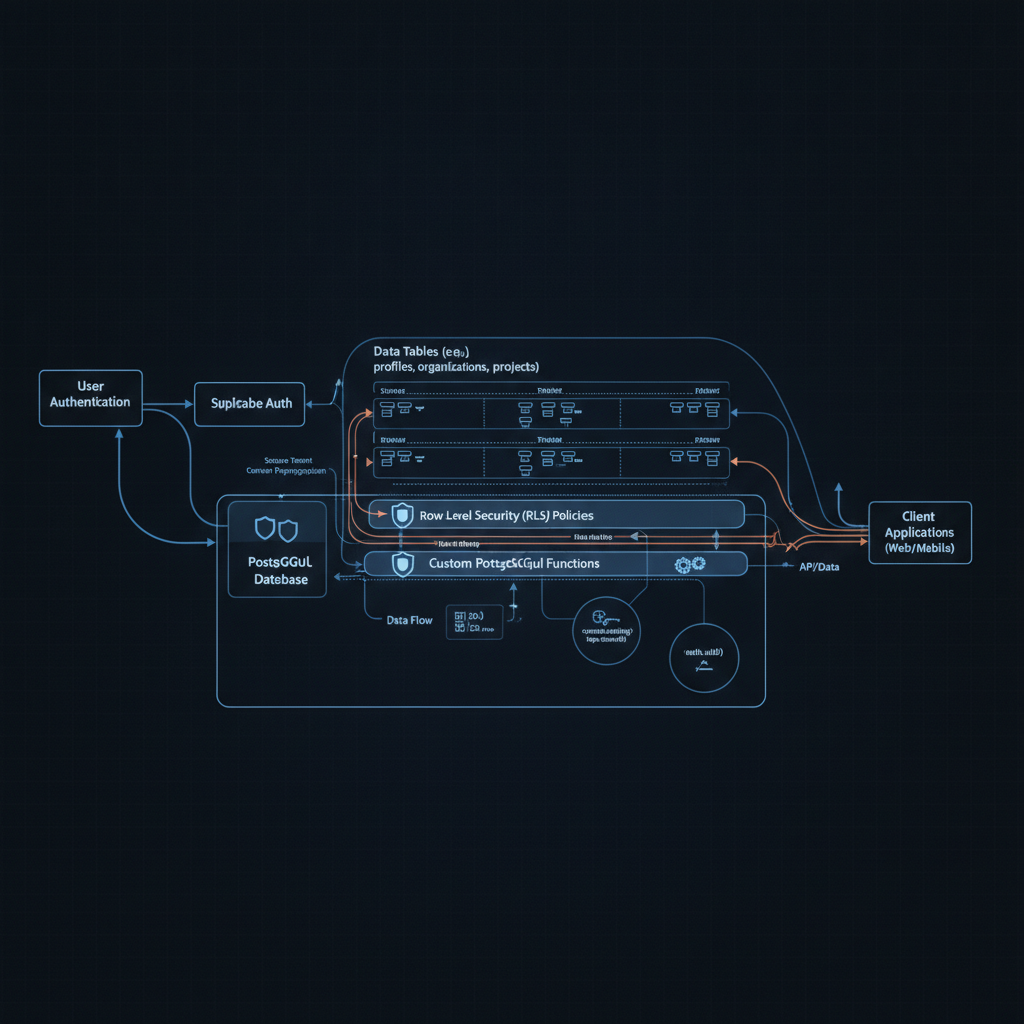
You're building a multi-tenant SaaS application on Supabase, and you've hit the critical juncture: how do you ensure absolute data isolation between your tenants? It's not enough to simply add a tenant_id column and call it a day. Senior engineers, technical founders, and CTOs know that basic Row-Level Security (RLS) policies, while powerful, often fall short when confronted with the nuances of production-grade multi-tenancy, shared data, or privileged operations. You need a bulletproof strategy that accounts for application-level context, administrative access, and background jobs without compromising security or performance.
This article cuts through the noise to provide a practical guide to advanced Supabase RLS, focusing on current_setting, custom PostgreSQL functions, and secure context propagation from your application backend. We'll move beyond the default auth.uid() to a more flexible and robust system that can handle the complexities of your growing SaaS.
TL;DR
- Basic RLS with
auth.uid()is insufficient for complex multi-tenant SaaS;current_settingoffers greater flexibility. - Propagate
tenant_idsecurely from your application's backend to the PostgreSQL session usingset_configor custom RPC functions. - Design RLS policies that leverage
current_setting('app.tenant_id')for tenant-specific data access. - Implement custom PostgreSQL functions (
SECURITY DEFINER) to manage session context securely and encapsulate complex logic. - Address edge cases like super-admin access, shared data, and background service operations with carefully crafted policies and roles.
The Core Challenge: Beyond Basic RLS
Supabase's Row-Level Security is a game-changer for data isolation. For many simple applications, a policy like `CREATE POLICY