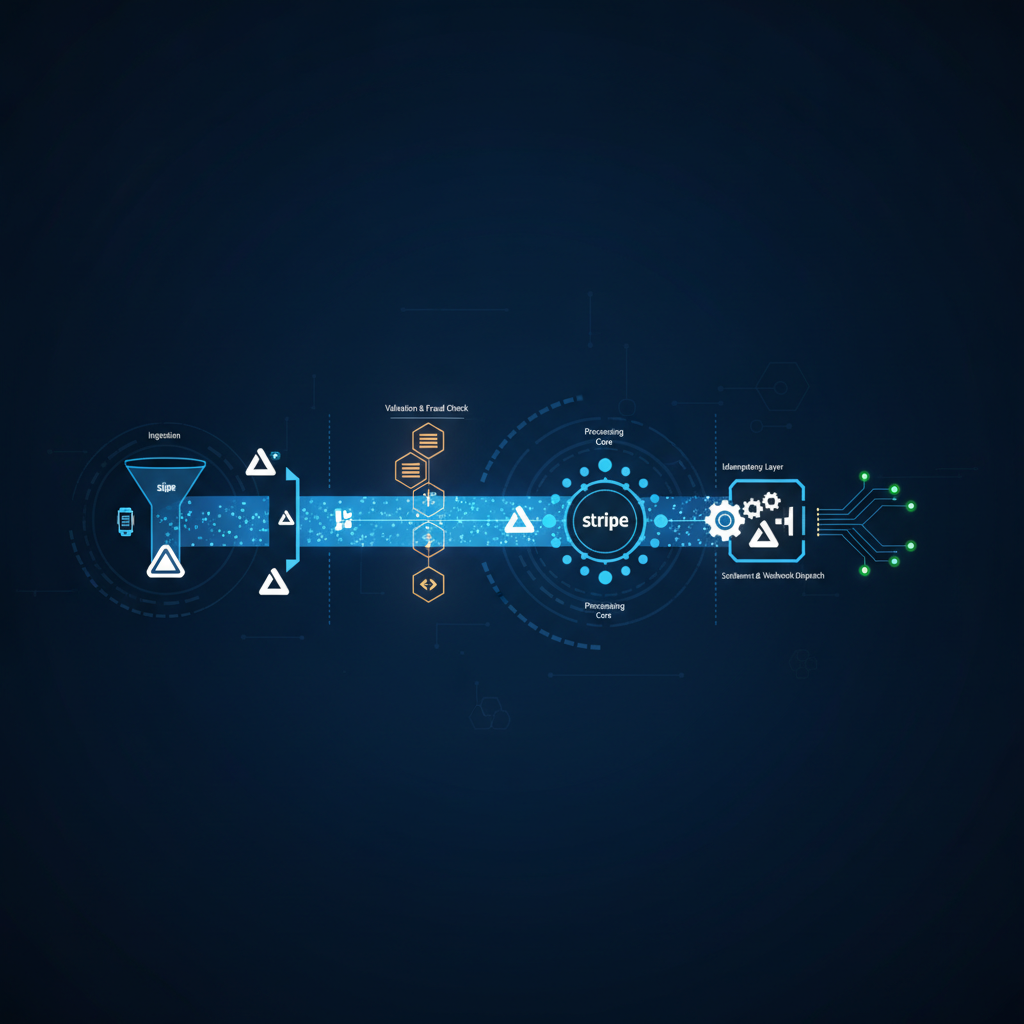
If you're building a Stripe Connect marketplace in Next.js, you've likely encountered the hair-pulling challenge of ensuring every webhook event is processed exactly once, in the correct order, without data corruption. This isn't a theoretical problem; it's a production reality that manifests as duplicate charges, incorrect user balances, and frustrated customers. When you're dealing with financial transactions, 'eventual consistency' isn't just a buzzword; it's a high-stakes game where missed or duplicated events can directly impact your revenue and your users' trust.
This article is for the technical founder or CTO who's already integrated Stripe Connect, understands the basics, but is now battling the edge cases: webhook retries, network glitches, serverless cold starts, and the subtle race conditions that can turn a seemingly robust system into a data integrity nightmare. We'll dive deep into implementing bulletproof idempotency, handling retries gracefully, and securing your webhook processing pipeline.
TL;DR
- Idempotency is paramount: Implement a robust mechanism to ensure each Stripe webhook event is processed exactly once, even with multiple deliveries.
- Store processed event IDs: Use your database to record
stripe-signatureandidfrom theStripe.Eventobject to prevent reprocessing. - Handle retries and out-of-order events: Design your handlers to be resilient to Stripe's retry logic and non-guaranteed delivery order.
- Mitigate race conditions: Employ optimistic locking or transaction management when updating state based on related events.
- Secure your endpoint: Always verify Stripe signatures and consider IP whitelisting for an extra layer of defense.
The Idempotency Imperative: Why It's Critical
Stripe's webhook system is designed for reliability, but it operates on an 'at-least-once' delivery model. This means you might receive the same event multiple times, or events might arrive out of order. For critical financial operations like updating a user's balance, crediting a seller, or marking an order as paid, processing an event twice can lead to severe inconsistencies and financial losses. This is where idempotency becomes not just a best practice, but a hard requirement.
Idempotency, in this context, means that applying an operation multiple times has the same effect as applying it once. For Stripe webhooks, this translates to: if your webhook handler receives the same payment_intent.succeeded event twice, your system should only credit the user/seller once.
Stripe's Idempotency Keys vs. Webhook Event Idempotency
It's important to distinguish between two related concepts:
- Stripe API Idempotency Keys: When you make an API request to Stripe (e.g., creating a charge), you can provide an
Idempotency-Keyheader. If the request fails and you retry with the same key, Stripe guarantees the operation is only performed once. This prevents duplicate charges if your network request times out. - Webhook Event Idempotency: This is what we're focused on. It's about ensuring your own system processes a received webhook event exactly once, regardless of how many times Stripe sends it. Stripe provides a unique
idfor each event, and astripe-signatureheader for verification, but your application is responsible for the 'exactly-once' processing guarantee.
Implementing Webhook Idempotency in Next.js
The most robust way to achieve webhook idempotency is to record the id of every processed Stripe event in your database. Before processing any event, check if its id already exists. If it does, you've already processed it, and you can safely return a 200 OK status without re-executing your business logic.
Storing Processed Event IDs
You'll need a table in your database to store processed webhook event IDs. A simple webhook_events table might look like this (using PostgreSQL/Prisma syntax):
// schema.prisma
model WebhookEvent {
  id          String    @id @map("stripe_event_id")
  eventType   String    @map("event_type")
  receivedAt  DateTime  @default(now()) @map("received_at")
  processedAt DateTime? @map("processed_at")
  payload     Json

  @@map("webhook_events")
}
The stripe_event_id column will store the unique id from the Stripe.Event object. Making it the primary key ensures uniqueness at the database level.
Next.js App Router Webhook Handler Example
Here's how you might structure your route.ts file for a Stripe webhook endpoint in the Next.js App Router, incorporating idempotency and signature verification:
// app/api/stripe/webhooks/route.ts

import { NextRequest, NextResponse } from 'next/server';
import Stripe from 'stripe';
import { buffer } from 'micro'; // For raw body access in Next.js API Routes
import { prisma } from '@/lib/prisma'; // Your Prisma client instance

const stripe = new Stripe(process.env.STRIPE_SECRET_KEY!, {
  apiVersion: '2024-04-10',
});

const webhookSecret: string = process.env.STRIPE_WEBHOOK_SECRET!;

// Disable body parsing for this route to get raw body
export const config = {
  api: {
    bodyParser: false,
  },
};

export async function POST(req: NextRequest) {
  const rawBody = await buffer(req);
  const signature = req.headers.get('stripe-signature');

  if (!signature) {
    return NextResponse.json({ error: 'No Stripe signature header' }, { status: 400 });
  }

  let event: Stripe.Event;

  try {
    event = stripe.webhooks.constructEvent(
      rawBody,
      signature,
      webhookSecret
    );
  } catch (err: any) {
    console.error(`⚠️ Webhook signature verification failed.`, err.message);
    return NextResponse.json({ error: `Webhook Error: ${err.message}` }, { status: 400 });
  }

  // Idempotency check: Has this event already been processed?
  try {
    const existingEvent = await prisma.webhookEvent.findUnique({
      where: { id: event.id },
    });

    if (existingEvent) {
      console.log(`Received duplicate event ${event.id}. Skipping processing.`);
      return NextResponse.json({ received: true, message: 'Event already processed' }, { status: 200 });
    }

    // Record the event as received before processing to prevent race conditions on subsequent retries
    await prisma.webhookEvent.create({
      data: {
        id: event.id,
        eventType: event.type,
        payload: event as any, // Store full payload for debugging
      },
    });

  } catch (dbError) {
    console.error(`Database error during idempotency check for event ${event.id}:`, dbError);
    // If we fail to record the event, we should ideally log and potentially retry or alert.
    // For now, we'll let it proceed, but be aware of potential duplicates if this fails consistently.
    // A more robust solution might involve a distributed lock or a transactional approach.
  }

  // Process the event based on its type
  try {
    switch (event.type) {
      case 'customer.subscription.created':
        // Handle new subscription logic
        const subscription = event.data.object as Stripe.Subscription;
        console.log(`Subscription created: ${subscription.id} for customer ${subscription.customer}`);
        // Update user's subscription status in your database
        break;
      case 'payment_intent.succeeded':
        const paymentIntent = event.data.object as Stripe.PaymentIntent;
        console.log(`Payment Intent succeeded: ${paymentIntent.id}`);
        // Fulfill order, credit seller, update user balance, etc.
        // Ensure this logic is also idempotent or transactional
        break;
      case 'charge.refunded':
        const charge = event.data.object as Stripe.Charge;
        console.log(`Charge refunded: ${charge.id}`);
        // Debit seller, revert order status, etc.
        break;
      // ... handle other event types relevant to your marketplace
      default:
        console.warn(`Unhandled event type ${event.type}`);
    }

    // Mark the event as processed (optional, but good for tracking)
    await prisma.webhookEvent.update({
      where: { id: event.id },
      data: { processedAt: new Date() },
    });

    return NextResponse.json({ received: true }, { status: 200 });
  } catch (processingError) {
    console.error(`Error processing event ${event.id} of type ${event.type}:`, processingError);
    // Return 500 to tell Stripe to retry
    return NextResponse.json({ error: 'Event processing failed' }, { status: 500 });
  }
}
Important Note on micro: Next.js App Router Request objects provide req.text() or req.json() for body parsing. However, for Stripe webhook verification, you need the raw body. The micro package's buffer utility is a common way to get this in Next.js API Routes (and works similarly for App Router if you disable bodyParser). If using req.text() directly, ensure it returns the raw string without any implicit JSON parsing.
Beyond Idempotency: Handling Retries and Delivery Guarantees
Stripe will retry sending webhooks with exponential backoff if your endpoint returns a non-2xx status code. This is crucial for resilience. Your idempotency logic ensures that even if retries happen, your system doesn't duplicate work.
However, what if an event consistently fails after multiple retries? Stripe eventually gives up. For critical events, you need a strategy:
- Monitoring and Alerting: Set up alerts for repeated
5xxresponses from your webhook endpoint. Tools like Sentry, Datadog, or even simple email alerts can notify you of issues. - Dead-Letter Queues (DLQs): For truly unprocessable events (e.g., malformed data, unhandled business logic errors), consider sending them to a DLQ (e.g., AWS SQS, a dedicated database table) for manual inspection and reprocessing. This prevents blocking the main processing queue.
- Manual Replay: Stripe allows you to manually resend webhook events from your dashboard. This is your last resort for truly stuck events.
Preventing Race Conditions in Event Processing
Even with idempotency, race conditions can occur if multiple related events arrive simultaneously or out of order. Consider a scenario where a payment_intent.succeeded event and a charge.refunded event for the same underlying transaction arrive. If the refund is processed before the successful payment, your system might incorrectly debit funds that were never credited.
Strategies to mitigate this:
- Optimistic Locking: When updating a record (e.g., user balance, order status), include a
versionorupdatedAttimestamp. Before committing changes, check if theversionstill matches the one you read. If not, another process modified the record, and you should re-read and retry. Prisma'supdateManywith awhereclause on theversioncan help here. - Transactional Updates: Group related database operations into a single transaction. This ensures atomicity: either all operations succeed, or all are rolled back. For example, when fulfilling an order, update the order status and credit the seller within one database transaction.
- Sequential Processing (for specific contexts): In some high-stakes scenarios, you might need to ensure certain event types for a given entity are processed strictly sequentially. This can be achieved with message queues that guarantee ordering (e.g., Kafka with partition keys, or a custom queue with a
processing_lockcolumn in your database).
For most Stripe Connect marketplaces, a combination of robust idempotency and careful transactional logic around critical state changes is usually sufficient.
Securing Your Webhook Endpoint
Your webhook endpoint is a critical entry point into your system. It must be secured to prevent malicious actors from injecting fake events or triggering unintended actions.
- Stripe Signature Verification (Mandatory): As shown in the code example, always verify the
stripe-signatureheader. This ensures the event genuinely came from Stripe and hasn't been tampered with. Never skip this step. - HTTPS Only: Ensure your webhook endpoint is served over HTTPS. This encrypts the data in transit, protecting against eavesdropping.
- IP Whitelisting (Optional but Recommended): Stripe publishes a list of IP addresses from which webhooks originate. You can configure your firewall or cloud provider (e.g., AWS Security Groups, Vercel firewall rules) to only accept requests from these IPs. This adds an extra layer of defense, though it requires maintenance as Stripe's IP ranges can change.
- Least Privilege: Your webhook handler should only have the necessary permissions to perform its designated tasks. Avoid giving it broad database write access if it only needs to update specific tables.
Error Handling and Observability
Even with the best engineering, things go wrong. Your system needs to tell you when they do.
- Comprehensive Logging: Log every incoming webhook event, its type, ID, and the outcome of its processing (success, failure, skipped as duplicate). Include full stack traces for errors.
- Monitoring and Alerting: Set up monitoring for your webhook endpoint's latency, error rates (
5xxresponses), and throughput. Configure alerts for spikes in errors or sustained failures. - Refund and Error Paths: Design explicit paths for handling refunds. Ensure that a
charge.refundedevent correctly reverses the financial impact of the originalpayment_intent.succeededevent. Test these paths thoroughly.
Key Takeaways
- Idempotency is your shield: Protect your data from duplicate webhook events by storing and checking event IDs.
- Verify signatures, always: Prevent unauthorized access and malicious data injection.
- Anticipate failure: Design for retries, out-of-order delivery, and unprocessable events with DLQs and manual intervention paths.
- Guard against race conditions: Use transactional logic or optimistic locking for critical state updates.
- Monitor relentlessly: Know when your webhook processing pipeline is experiencing issues.
Ship this without the trial-and-error
Building a robust Stripe Connect marketplace with bulletproof webhook reliability is complex. It involves nuanced understanding of payment flows, distributed systems, and production edge cases that generic AI tools often miss. If you're looking to accelerate your development and ensure your payment infrastructure is built to scale and withstand real-world conditions, PolarSoftBD specializes in Production Payments & AI Engineering.
We build Stripe Connect marketplaces, subscription platforms, and AI SaaS applications for technical founders and CTOs who demand precision and reliability. Don't spend months debugging subtle race conditions or webhook duplications. Leverage our deep expertise to get it right the first time.
Explore our Stripe Integration Services or Schedule a Free Strategy Call.
Further Reading: