TL;DR: UCLA played a pivotal role in the birth of the internet, hosting the first ARPANET node and sending the first message. This article explores the engineering challenges and innovations in packet switching, network protocols, and distributed systems that emerged from UCLA, laying the groundwork for modern global connectivity and offering timeless lessons for today's tech architects.
In the annals of technological progress, few institutions can claim a more foundational role in shaping the modern world than UCLA. While often celebrated for its academic prowess and research across myriad disciplines, its contribution to the very fabric of global communication – the internet – is particularly noteworthy for any engineering blog. Long before the ubiquitous web, streaming services, or cloud computing, a small team at UCLA was at the epicenter of a revolution, laying the groundwork for what would become the most transformative network in human history.
The Dawn of Packet Switching
The mid-20th century saw the rapid advancement of computing, yet these powerful machines largely operated in isolation. Accessing remote resources or sharing computational power was a significant challenge. Traditional telephone networks, based on circuit switching, established a dedicated, continuous connection for the duration of a call. While effective for voice, this model was highly inefficient for bursty data traffic, where long periods of silence (or inactivity) would tie up valuable network resources.
The Advanced Research Projects Agency (ARPA) recognized this limitation and envisioned a robust, distributed network that could withstand outages and efficiently share computing resources among researchers. The solution lay in packet switching – a revolutionary concept where data is broken into small, independent packets, each routed individually across the network and reassembled at the destination. This approach promised greater efficiency, resilience, and flexibility.
UCLA's Crucial Role: The First Node
At the forefront of this pioneering effort was Professor Leonard Kleinrock at UCLA's School of Engineering and Applied Science. Kleinrock's groundbreaking theoretical work on queuing theory in the early 1960s provided the mathematical framework necessary to understand and predict the behavior of packet-switched networks. His insights were instrumental in demonstrating the feasibility and efficiency of such a system.
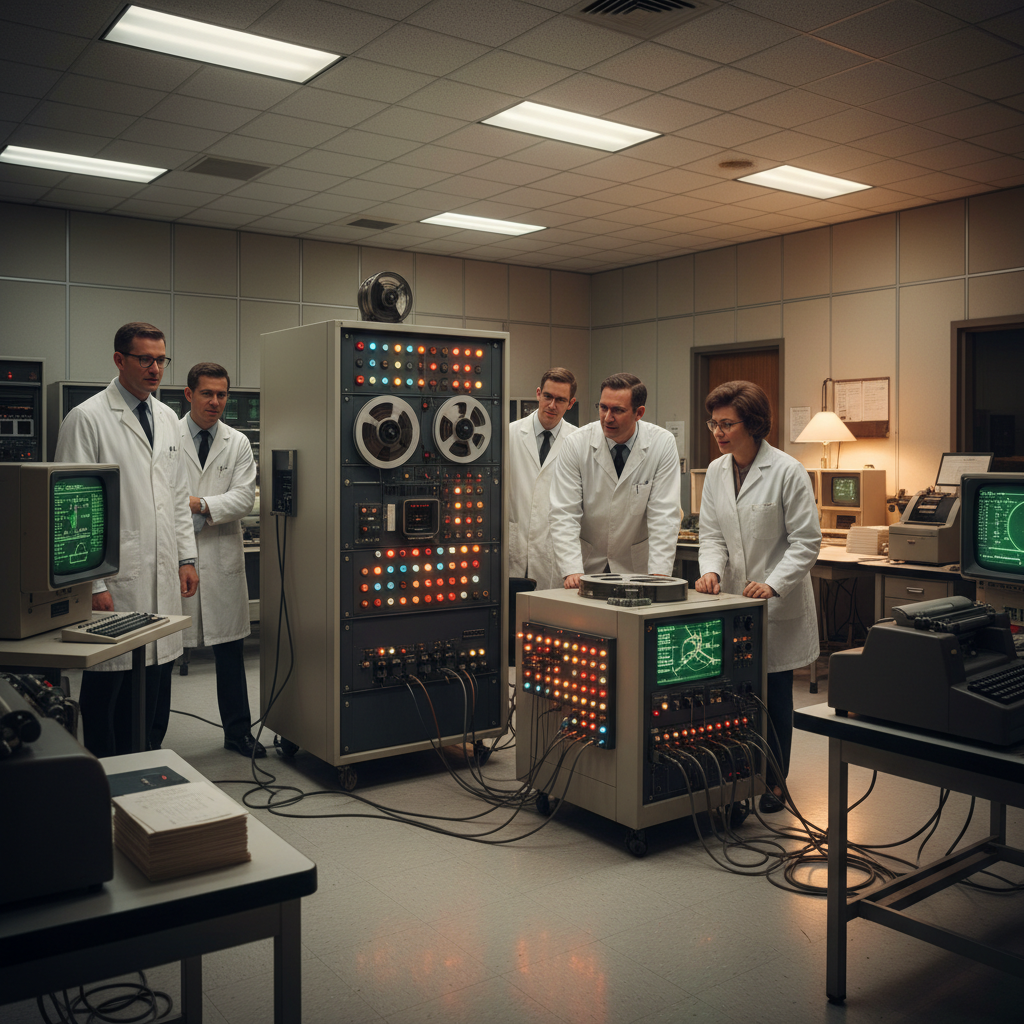
It was no coincidence then that UCLA was chosen to host the first Interface Message Processor (IMP) – the specialized minicomputer that served as the network's router – and thus the very first node of the ARPANET. On October 29, 1969, at approximately 10:30 PM PST, a historic moment unfolded. A small team, led by Kleinrock and programmer Charley Kline, attempted to log in remotely from UCLA's SDS Sigma 7 computer to an SRI (Stanford Research Institute) computer. The message they intended to send was 'LOGIN'.
The initial attempt was fraught with the challenges typical of nascent technology. They successfully typed 'L' and 'O' before the system crashed. However, a few minutes later, they re-established the connection and successfully transmitted the full 'LOGIN' command. While seemingly mundane, this simple act marked the first electronic message ever sent over a packet-switched computer network, igniting the digital age.
Engineering Challenges and Innovations
The development of ARPANET was an immense engineering undertaking. Researchers at UCLA and other participating institutions faced a multitude of challenges. How do you ensure packets arrive in the correct order? What happens if a packet is lost? How do different types of computers communicate effectively? These questions led to fundamental innovations in network protocols.
The initial host-to-host protocol, Network Control Program (NCP), was developed to manage connections and data flow between different computers. This was a critical step in abstracting the underlying network complexities from application developers. The decentralized nature of ARPANET also necessitated robust routing algorithms that could dynamically adapt to network changes and failures, a concept that underpins much of today's internet infrastructure.
The interdisciplinary nature of the project also fostered a unique collaborative environment. Engineers, computer scientists, and mathematicians worked together to solve problems that had no precedent. The challenges ranged from designing the hardware for the IMPs to writing the complex software that managed packet flow, error checking, and host communication. This period was a crucible for many of the distributed computing principles we now take for granted.
Beyond ARPANET: A Legacy of Innovation
ARPANET, while revolutionary, was just the beginning. The lessons learned and the technologies developed at UCLA and its partner institutions paved the way for the evolution into the modern internet. The limitations of NCP led to the development of TCP/IP (Transmission Control Protocol/Internet Protocol) in the 1970s, a protocol suite designed for internetworking – connecting multiple distinct networks together. UCLA researchers continued to contribute significantly to the refinement and standardization of these protocols.
UCLA's legacy extends far beyond its initial ARPANET node. The university has remained a hub for internet research, contributing to areas like network performance, security, and the development of new applications. The foundational work in distributed systems, fault tolerance, and efficient data transmission continues to influence contemporary fields such as cloud computing, edge computing, and large-scale data processing. Every time data flows seamlessly across continents, a piece of that original UCLA innovation is at work.
Lessons for Today's Engineers
The story of UCLA and ARPANET offers invaluable lessons for engineers and architects working on complex systems today:
- Embrace Foundational Research: Kleinrock's theoretical work was not immediately practical but provided the essential bedrock for a revolutionary technology. Investing in deep, theoretical research often yields the most transformative breakthroughs.
- Prioritize Collaboration: The ARPANET was a collaborative effort across multiple institutions. Solving grand challenges requires diverse expertise and open communication.
- Design for Resilience and Scalability: From its inception, ARPANET was designed to be robust and distributed. This foresight ensured its ability to grow and adapt, a critical principle for any modern system.
- Iterate and Evolve: The journey from NCP to TCP/IP demonstrates the importance of continuous improvement and adaptation in the face of new requirements and understanding. Technologies are not static; they must evolve.
- Abstract Complexity: The development of protocols like NCP and later TCP/IP allowed developers to build applications without needing to understand the intricate details of the underlying network hardware, a core tenet of good software design.
Conclusion
UCLA's pioneering work in the late 1960s did more than just connect a few computers; it ignited a paradigm shift in how information is shared and processed globally. The spirit of innovation, the rigorous engineering, and the collaborative ethos that defined the ARPANET project at UCLA continue to resonate, offering a powerful reminder of how foundational research and bold engineering can truly architect the future. For anyone building distributed systems or grappling with network challenges today, understanding this rich history is not just an academic exercise – it's an insight into the enduring principles that make our connected world possible.