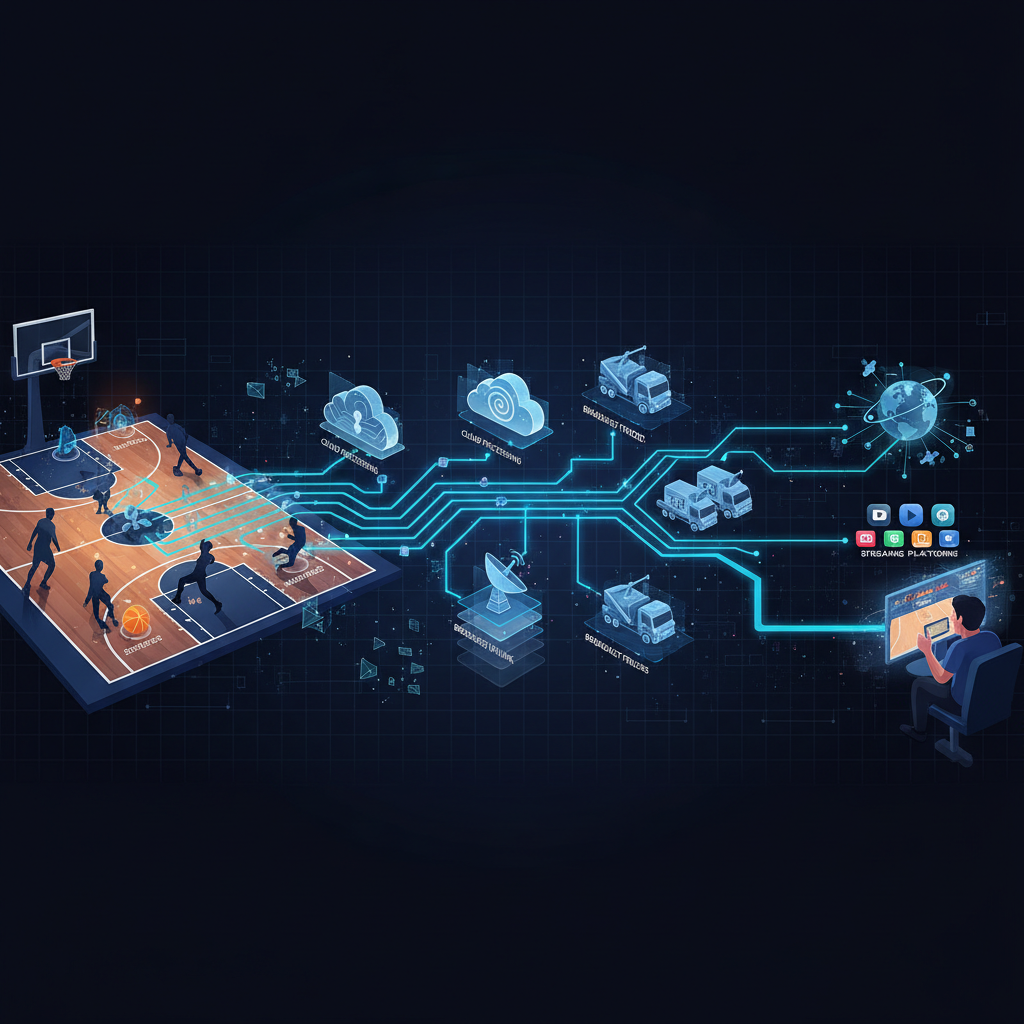
TL;DR: Live professional basketball broadcasts are a marvel of modern engineering, relying on sophisticated tech stacks for real-time data acquisition, low-latency global distribution, and interactive fan engagement. This article explores the complex systems, from optical tracking and cloud-native data pipelines to content delivery networks and personalized viewing experiences, that converge to deliver the spectacle of a 'warriors game' to millions.
The Unseen Game: Engineering the Spectacle
When we tune in to watch a high-stakes professional basketball game, our focus is naturally on the athletes, the strategy, and the unfolding drama. Yet, beneath the surface of every slam dunk and three-pointer lies a colossal engineering effort. The seamless delivery of a live 'warriors game' to millions of viewers across the globe is a testament to advanced data engineering, robust networking, and scalable software architecture. This isn't just about cameras and cables; it's about real-time data processing, ultra-low latency streaming, and an ever-evolving digital ecosystem designed to capture, analyze, and distribute every moment.
Capturing the Action: Data at the Speed of Play
The foundation of modern sports broadcasting and analytics is data acquisition. For a basketball game, this involves capturing granular details about player movement, ball trajectory, and tactical formations. This isn't manual; it's automated and precise.
Optical tracking systems, such as those developed by companies like Second Spectrum (used by the NBA), employ multiple high-resolution cameras strategically placed around the arena. These cameras continuously track every player and the ball, generating massive datasets of X-Y coordinates at high frame rates – often 25 times per second or more. These systems can identify individual players, differentiate between offensive and defensive actions, and even measure subtle movements like acceleration and deceleration.
While less common for in-game player tracking due to regulatory and practical challenges, wearable sensors are critical in training environments, providing biometric data, load management insights, and more. The integration of these diverse data streams presents a significant engineering challenge: how to ingest, normalize, and process vast quantities of heterogeneous data in real-time without introducing significant latency.
The Data Pipeline: From Court to Cloud
Once captured, the raw data embarks on a high-speed journey through a sophisticated data pipeline. This pipeline is designed for both immediacy and depth of analysis.
Initial processing often occurs at the 'edge' – servers located close to the arena. This edge computing minimizes latency by performing crucial tasks like data filtering, aggregation, and initial feature extraction before sending it further upstream. For instance, converting raw pixel data into meaningful player coordinates and events (e.g., 'shot attempt', 'pass') happens here.
From the edge, the processed data is typically streamed to cloud-based infrastructure. Modern sports analytics platforms leverage hyperscale cloud providers for their scalability, global reach, and specialized services. Here, real-time stream processing engines (e.g., Apache Flink, Kafka Streams) ingest the data, allowing for instantaneous calculations of player efficiency ratings, shot percentages, defensive metrics, and more. This data is then made available to broadcasters for on-screen graphics, to coaching staff for in-game adjustments, and to media partners for various applications.
The sheer volume and velocity of this data demand highly optimized databases and storage solutions, often a mix of low-latency in-memory databases for real-time lookups and scalable data lakes for historical analysis and machine learning model training.
Broadcasting Brilliance: Delivering the Live Experience
Delivering the live video feed is an equally complex undertaking. Multiple high-definition cameras, including specialized super slo-mo and aerial cameras, capture the action. These feeds converge in a mobile production truck or a remote control room, where technical directors, producers, and graphic operators orchestrate the live broadcast.
Contribution networks, often relying on dedicated fiber optic lines or satellite uplinks, transport the high-bandwidth video streams from the arena to broadcast centers. These networks are engineered for maximum reliability and minimal latency, as even a few seconds of delay can impact the viewer's experience.
For global distribution, content delivery networks (CDNs) play a pivotal role. CDNs cache video content at edge locations worldwide, ensuring that viewers receive the stream from a server geographically close to them. This minimizes latency and reduces buffering, critical for a smooth live viewing experience. Adaptive bitrate streaming dynamically adjusts video quality based on the viewer's internet connection, ensuring optimal performance across diverse network conditions.
Enhancing Engagement: Interactive Fan Experiences
The integration of data and broadcasting has revolutionized fan engagement. Gone are the days of static scoreboards; today's broadcasts are dynamic, interactive experiences.
Real-time statistics overlays, powered by the data pipelines described earlier, provide instant insights into player performance, team comparisons, and game momentum. Augmented reality (AR) graphics can project virtual statistics, player tracking lines, or even simulated trajectories onto the court, enriching the visual narrative.
Beyond the primary broadcast, many platforms offer personalized viewing options. Fans can choose from multiple camera angles, access player-specific feeds, or replay key moments instantly. This level of customization is enabled by sophisticated backend systems that manage vast libraries of video assets and deliver them on demand.
Furthermore, the real-time data fuels fantasy sports platforms, live betting applications, and social media integrations, allowing fans to interact with the game in unprecedented ways. These applications rely on robust APIs and low-latency data feeds to provide up-to-the-second information.
The Engineering Challenges: Scale, Speed, Security
Building and maintaining this infrastructure comes with significant engineering challenges:
- Scalability: Systems must handle massive spikes in traffic during peak viewing times, especially for major events, without degradation in performance.
- Latency: For live sports, every millisecond counts. Data must be processed and delivered with sub-second latency to remain relevant for broadcasters, coaches, and interactive applications.
- Data Accuracy: The integrity of the data is paramount. Errors in tracking or statistics can lead to incorrect analyses and frustrate fans.
- Resilience and Redundancy: Critical systems must have built-in redundancy to prevent single points of failure, ensuring continuous operation even in the face of hardware malfunctions or network disruptions.
- Cybersecurity: Protecting sensitive broadcast streams, player data, and fan information from cyber threats is an ongoing and evolving challenge.
The Future of Sports Tech: A Glimpse Ahead
The evolution of sports technology shows no signs of slowing. We can anticipate even greater integration of immersive technologies like virtual reality (VR) and mixed reality (MR), offering fans entirely new ways to experience games. Predictive analytics, driven by advanced machine learning models, will provide deeper strategic insights for teams and more engaging narratives for broadcasters.
Hyper-personalized content delivery, where each viewer receives a unique stream tailored to their preferences (e.g., focusing on a favorite player, specific analytics), will become more commonplace. Edge computing will continue to grow in importance, bringing processing power even closer to the action and enabling new low-latency applications.
Conclusion: The Silent Architects of Spectacle
The next time you settle in to watch a 'warriors game', take a moment to appreciate the silent architects behind the spectacle. From the precise optical sensors tracking every move to the global network of servers delivering the stream, a vast and intricate technological ecosystem is at play. It's a continuous cycle of innovation, driven by the desire to push the boundaries of what's possible in live sports entertainment, proving that the most exciting plays often happen not just on the court, but within the complex engineering systems that bring them to life.