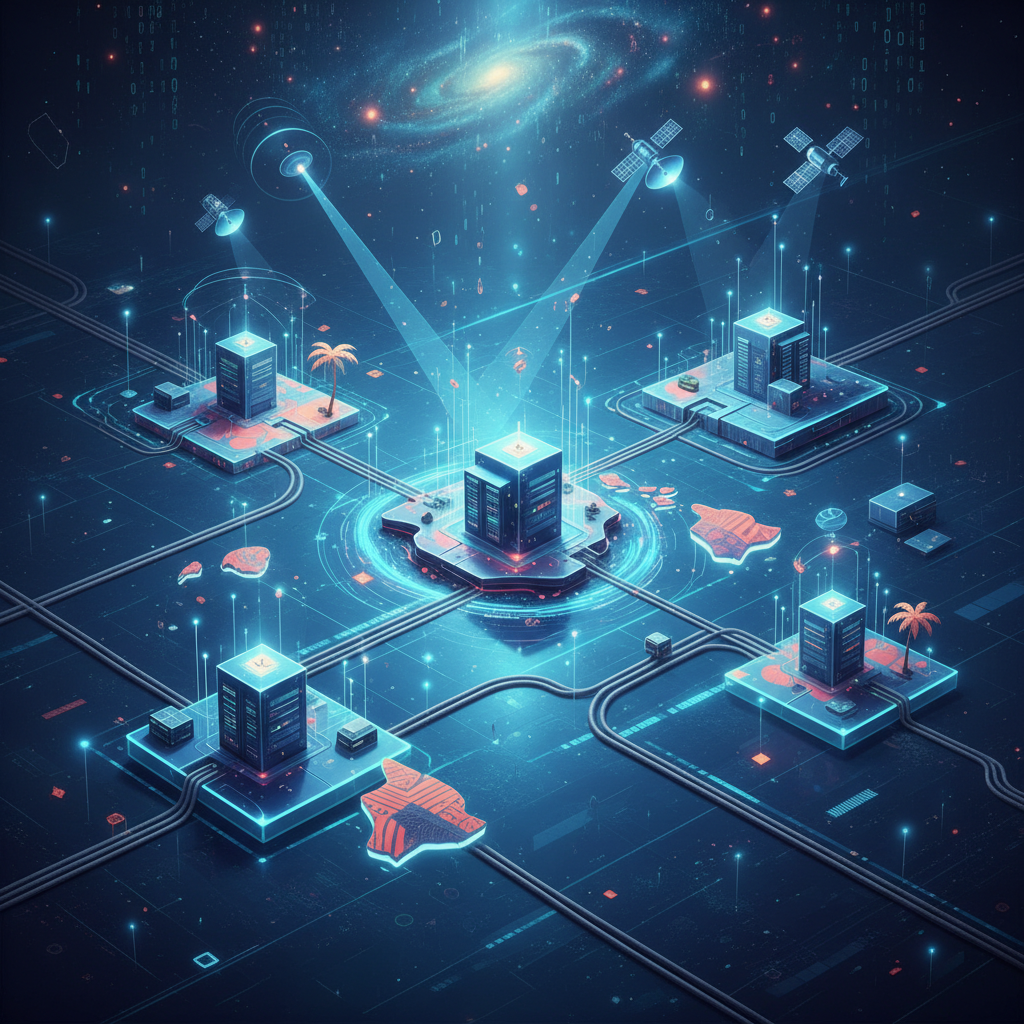
TL;DR Building reliable information networks for island communities like those in Hawaii presents unique engineering challenges, from vulnerable submarine cables to geographical dispersion. This article explores how a multi-layered approach, combining robust physical infrastructure with advanced software solutions like edge computing, mesh networks, and intelligent data caching, is crucial for ensuring consistent, high-speed access to news and essential services, especially during emergencies.
The Archipelago's Network Quandary
Island nations and states, particularly those forming archipelagos, face a distinct set of hurdles when it comes to establishing and maintaining modern, high-speed information networks. Unlike continental landmasses where redundancy can often be achieved through diverse terrestrial routes, islands are inherently isolated. This isolation translates directly into engineering complexities for data transmission, affecting everything from daily news consumption to critical emergency communications.
The challenge isn't merely about connecting a few points; it's about creating a resilient web across vast oceanic distances, often with significant seismic activity or extreme weather events. For residents and businesses, reliable connectivity is not a luxury but a fundamental requirement for economic stability, education, healthcare, and access to timely information, including local news.
Submarine Cables: The Digital Lifelines
At the heart of inter-island and international connectivity for most archipelagos are submarine fiber optic cables. These delicate yet powerful conduits carry the vast majority of internet traffic, linking islands to each other and to the global internet backbone. Engineering these cables involves meticulous planning, surveying deep ocean trenches, and deploying specialized ships capable of laying thousands of kilometers of cable.
However, these lifelines are vulnerable. They can be severed by ship anchors, fishing trawlers, underwater landslides, or seismic events. A single cable cut can dramatically reduce bandwidth, increase latency, or even completely isolate an island. Designing for resilience therefore necessitates diverse routing, ideally with multiple cables landing at different points and connecting to different international hubs, though this is often a costly and complex endeavor for smaller economies.
Beyond the Cable: Satellite and Terrestrial Innovations
While submarine cables are primary, a multi-modal approach is essential for true resilience. Satellite communication plays a crucial role, particularly for remote islands or as a backup in case of cable failure. Geostationary satellites (GEO) provide broad coverage but often come with higher latency. Low Earth Orbit (LEO) satellite constellations, like Starlink, are rapidly changing this landscape, offering lower latency and higher bandwidth alternatives that can be rapidly deployed.
On land, the challenge shifts to distributing connectivity across mountainous terrains, dense urban areas, and remote rural communities. Terrestrial fiber optic networks, microwave links, and advanced wireless technologies (like 5G and fixed wireless access) are deployed. Engineers must contend with geographical obstacles, environmental factors, and the cost-effectiveness of reaching every last mile. The goal is to build a robust mesh of interconnected nodes that can self-heal or reroute traffic in the event of local failures.
Edge Computing and Local Caching for Speed and Resilience
Even with robust physical infrastructure, the sheer distance data must travel can introduce latency. This is particularly relevant for content delivery, such as streaming video, web browsing, and accessing local news updates. Edge computing offers a powerful solution by bringing computational resources and data storage closer to the end-users.
By deploying mini-data centers or content delivery network (CDN) nodes on individual islands or within specific communities, frequently accessed content can be cached locally. This means that when a user requests a popular news article or video, the data is served from the local edge node rather than traversing thousands of kilometers back to a continental server. This significantly reduces latency, improves user experience, and, critically, maintains access to cached content even if the primary submarine cable connection is temporarily disrupted.
Mesh Networks and Decentralized Architectures
For localized resilience, particularly within communities or across smaller island groups, mesh networking principles are gaining traction. In a mesh network, devices connect directly, dynamically, and non-hierarchically to as many other nodes as possible, forming a 'mesh' topology. If one path fails, data can automatically reroute through another.
These decentralized architectures can be particularly effective for local information dissemination during emergencies. Imagine a scenario where a central internet gateway fails; a local mesh network could still allow residents to communicate with each other, access locally hosted emergency information, or even receive critical news updates from a local server. This paradigm shifts from a single point of failure to a distributed, self-healing system, enhancing local autonomy and resilience.
Emergency Preparedness and Redundancy
The engineering principles discussed are not just about daily convenience; they are vital for disaster preparedness and response. Archipelagos are often on the front lines of climate change impacts, including hurricanes, tsunamis, and volcanic activity. Resilient communication networks are paramount for issuing warnings, coordinating rescue efforts, and providing post-disaster information to affected populations.
Redundancy is built into every layer: multiple physical routes for cables, diverse satellite options, and distributed terrestrial networks. Furthermore, portable and rapidly deployable communication solutions, such as satellite phones, mobile cellular towers (COWs - Cells On Wheels), and even drone-based communication relays, are part of a comprehensive emergency preparedness strategy.
The Human Element and Community-Driven Tech
Beyond the hardware and software, the human element plays a critical role. Local engineers, technicians, and community leaders are essential for understanding specific needs, maintaining infrastructure, and innovating solutions tailored to their unique environments. Open-source technologies and community-driven initiatives can empower local development and foster a sense of ownership over these vital networks.
Training local talent in network management, cybersecurity, and disaster recovery protocols ensures that these complex systems can be sustained and evolved by the communities they serve, making the networks not just technologically advanced but also socially resilient.
Conclusion
Engineering resilient information networks for archipelagos is a continuous, multi-faceted challenge. It demands innovative solutions that integrate robust physical infrastructure with intelligent software architectures. From the depths of the ocean where submarine cables lie, to the edge of the network where local content is cached, every component must be designed with resilience and redundancy in mind. The ultimate goal is to ensure that communities, regardless of their geographical isolation, have equitable and reliable access to the information they need to thrive, adapt, and respond to an ever-changing world, keeping them connected to vital news and global knowledge.