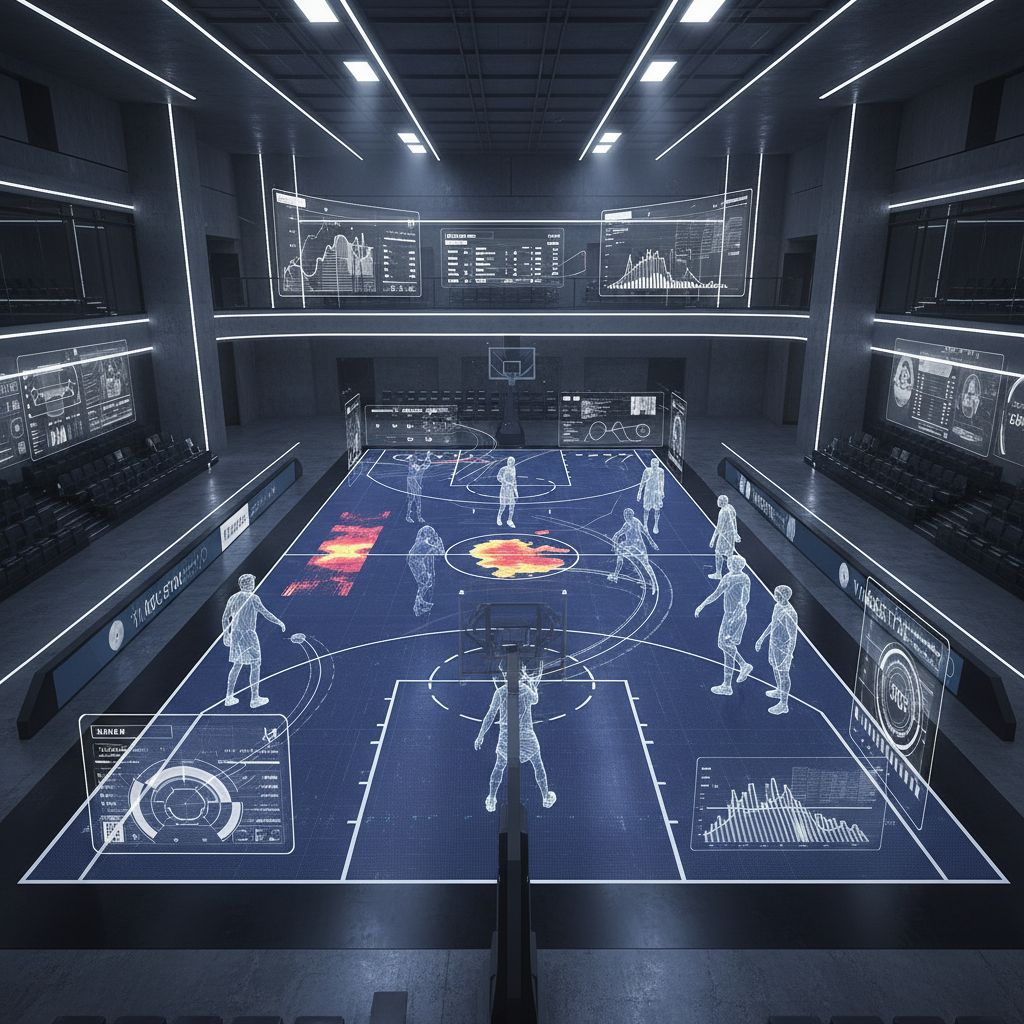
TL;DR: AI and computer vision offer new ways to proactively monitor player conduct, detect escalating situations, and inform disciplinary actions, enhancing fairness and safety in sports by providing objective data and early warning systems.
The Unseen Game: Navigating Player Conduct in High-Stakes Sports
Professional sports, with their intense rivalries and high stakes, are often arenas for both incredible athletic feats and moments of heated conflict. Incidents involving player conduct, such as the recent suspension of Isaiah Stewart, serve as stark reminders of the challenges leagues face in maintaining decorum, ensuring player safety, and upholding the integrity of the game. While human officials and disciplinary committees are central to managing these issues, their capacity is inherently limited by real-time observation and subjective interpretation. This presents a compelling case for exploring how technology, specifically artificial intelligence, can augment human efforts to create a more objective, proactive, and ultimately safer environment for athletes.
At PolarSoftBD, we recognize that the principles of robust system design and data-driven insights extend far beyond traditional software development. Applying these concepts to complex human systems, like professional sports governance, opens up innovative avenues for problem-solving. How can we move beyond reactive discipline to proactive prevention? The answer lies in leveraging advanced AI capabilities to provide a digital lens on player interactions.
The Human Element vs. Algorithmic Augmentation
The current paradigm for monitoring player conduct relies heavily on human observation—referees, sideline officials, and post-game review panels. While invaluable, this approach has inherent limitations. Human attention can be diverted, critical moments can be missed, and subjective biases can influence interpretations. Furthermore, identifying patterns of behavior that precede an incident can be challenging without comprehensive, consistent data.
This is where algorithmic augmentation comes into play. By deploying AI systems, leagues can gain access to a continuous, objective stream of data related to player interactions. This isn't about replacing human judgment but about providing a richer, more detailed, and less biased foundation upon which human decisions can be made. The goal is to create a system that can identify potential flashpoints before they escalate, offering early warnings and comprehensive evidence for review.
Computer Vision: Unpacking On-Court Dynamics
One of the most powerful applications of AI in this domain is computer vision (CV). Modern CV systems, equipped with high-resolution cameras strategically placed around an arena, can process vast amounts of visual data in real-time. For player conduct, this translates into several key capabilities:
Real-time Interaction Tracking
CV algorithms can accurately track the positions and movements of every player, official, and even key objects like the ball. Beyond simple tracking, techniques like pose estimation can analyze body language, identifying aggressive postures, sudden lunges, or unusual physical contact that might precede an altercation. Imagine a system that can detect the precise moment a player's hand makes contact with another player's face, or when a verbal exchange escalates into a physical shove, with millisecond precision.
Anomaly Detection
By establishing baselines for typical player interactions, CV systems can flag anomalies—actions or sequences of movements that deviate significantly from expected behavior. This could include unusual proximity between players from opposing teams outside of active play, prolonged aggressive staring, or sudden bursts of movement towards an opponent when the ball is elsewhere. These anomalies, while not necessarily indicative of an infraction on their own, can serve as early warning signals for officials to monitor a situation more closely.
Event Reconstruction
In the aftermath of an incident, CV can provide an unassailable, multi-angle reconstruction of events. This granular data, showing exact timings, trajectories, and points of contact, can be invaluable for disciplinary committees in determining the sequence of events, assessing intent, and applying consistent penalties. This moves beyond relying solely on limited broadcast angles or potentially biased eyewitness accounts.
Natural Language Processing: Beyond the Baseline
While computer vision focuses on the visual, natural language processing (NLP) can provide crucial context from the auditory and textual realms. Player conduct isn't limited to physical interactions; verbal altercations, social media activity, and pre/post-game statements can all contribute to or reflect underlying tensions.
Sentiment Analysis and Keyword Detection
NLP models can analyze transcripts of player interviews, social media posts, and even on-court audio (where permissible) to detect aggressive language, inflammatory statements, or shifts in sentiment. This doesn't mean policing every word, but rather identifying patterns or specific keywords that might indicate escalating frustration, threats, or unsportsmanlike conduct.
Contextual Understanding
Advanced NLP can move beyond simple keyword matching to understand the context and nuances of communication. For example, differentiating between competitive banter and genuinely threatening language, or identifying patterns in how certain players communicate that might precede disciplinary issues. This can help identify potential