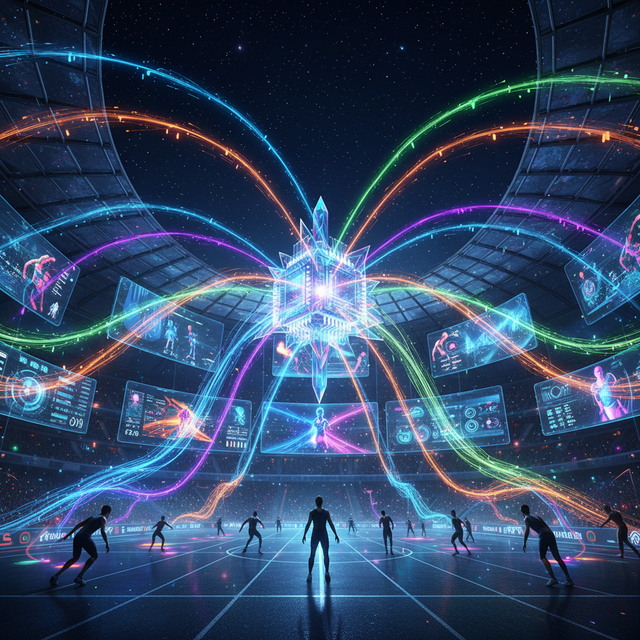
TL;DR: Modern sports are increasingly driven by sophisticated engineering, transforming both player performance analysis and fan engagement. This article explores the architectural challenges and solutions behind capturing, processing, and delivering real-time sports data, from sensor-laden athletes to immersive AR/VR broadcast experiences. We delve into data pipelines, stream processing, distributed systems, and the crucial role of low-latency infrastructure in making instantaneous insights and captivating fan interactions a reality.
The intersection of sports and technology has never been more dynamic. What was once primarily a physical spectacle has evolved into a data-rich, technologically augmented experience, both on the field and for the global audience. For engineers, this evolution presents a fascinating array of challenges, from processing torrents of real-time data to rendering complex immersive environments with ultra-low latency. At PolarSoftBD, we recognize that the thrill of the game is increasingly underpinned by robust, scalable, and intelligent engineering systems.
The Data Deluge: Capturing Every Action
Every professional sporting event today is a massive data generation engine. Players wear sensors tracking movement, heart rate, and biomechanics. High-speed cameras capture intricate details of ball trajectories, player positions, and tactical formations. Stadiums are becoming smart environments, monitoring everything from crowd flow to concession sales. This results in an unprecedented volume, velocity, and variety of data.
Consider a single football match: GPS trackers on players generate positional data multiple times per second. Optical tracking systems analyze every player and ball movement from various angles. Wearable sensors provide physiological metrics. All this data, often unstructured or semi-structured, needs to be collected, timestamped, and ingested into a system capable of handling bursts of millions of events per second. The engineering challenge here lies not just in collection, but in building resilient ingestion pipelines that can withstand network fluctuations and maintain data integrity at scale. Technologies like Apache Kafka or Amazon Kinesis are foundational, acting as highly scalable, fault-tolerant message brokers that buffer and distribute these continuous streams of events.
From Raw Data to Real-time Insights: The Engineering Pipeline
Once ingested, raw sports data is largely meaningless without processing. The goal is to transform this torrent into actionable insights in real-time. This requires a sophisticated data processing pipeline.
Stream processing frameworks like Apache Flink or Spark Streaming are critical here. These engines can process data records as they arrive, performing aggregations, transformations, and applying machine learning models with minimal latency. For instance, a system might calculate a player's "expected goals" probability based on their position, speed, and historical shot data, all within milliseconds of the event occurring. Or, it might identify fatigue patterns from biometric data to advise coaches on substitutions.
The architecture typically involves:
- Data Cleansing and Normalization: Standardizing formats, handling missing values, and correcting errors.
- Feature Engineering: Deriving new, more meaningful features from raw data (e.g., acceleration from positional data).
- Real-time Analytics: Aggregating metrics, detecting anomalies, and calculating key performance indicators (KPIs).
- Machine Learning Inference: Applying pre-trained models for predictive analytics (e.g., predicting injury risk, outcome probabilities) or prescriptive analytics (e.g., optimal tactical adjustments).
The choice of database is also crucial. For storing high-frequency time-series data, specialized databases like InfluxDB or TimescaleDB are often preferred due to their optimized storage and query capabilities for time-stamped events. For analytical queries and reporting, columnar databases or data warehouses might be used. The entire pipeline must be designed for low-latency, ensuring that insights are delivered before they lose their relevance.
Immersive Fan Experiences: Beyond the Screen
Beyond performance analysis, engineering plays a pivotal role in enhancing the fan experience. Broadcasters and content creators are leveraging technology to bring viewers closer to the action than ever before.
Augmented Reality (AR) Overlays: Live broadcasts frequently use AR to display real-time statistics, player tracking lines, or virtual advertisements directly onto the field of play. This requires precise camera tracking, real-time data integration, and high-performance rendering engines to seamlessly blend virtual elements with live video feeds. The engineering challenge is maintaining perfect synchronization and visual fidelity, often under demanding live conditions.
Virtual Reality (VR) and 360-degree Content: Some platforms offer VR experiences, allowing fans to "sit" courtside or in the stands, with the ability to look around and choose their viewing angle. This demands robust streaming infrastructure capable of delivering high-resolution, multi-directional video streams with minimal latency, along with sophisticated stitching and rendering algorithms.
Personalized Content Delivery: With the wealth of data available, engineering systems can now deliver highly personalized content. A fan following a specific player might receive real-time alerts on their performance statistics or highlights featuring only that player. This requires dynamic content generation and a recommendation engine powered by user preferences and real-time game data.
Interactive Stadium Experiences: Smart stadiums are integrating IoT devices, mobile apps, and location-based services to enhance the in-venue experience. From navigating to seats and ordering food to interactive displays and personalized replays, these systems rely on a complex interplay of network infrastructure, cloud services, and mobile application development.
The Backend Backbone: Ensuring Reliability and Scalability
All these innovations hinge on a robust and scalable backend infrastructure. Sports events are often global, with peak viewership and data generation occurring simultaneously across different time zones. This necessitates:
- Cloud-Native Architectures: Leveraging public cloud providers (AWS, Azure, GCP) allows for elastic scalability, enabling systems to dynamically adjust resources based on demand spikes, such as during major tournaments.
- Distributed Systems: Architectures built on microservices and containerization (Docker, Kubernetes) ensure that different components of the system can scale independently and fail gracefully without impacting the entire service.
- Fault Tolerance and Resilience: Given the live nature of sports, downtime is not an option. Redundancy, failover mechanisms, and robust error handling are paramount to ensure continuous operation.
- Security: Protecting sensitive player data, broadcast intellectual property, and fan information is critical, requiring stringent security protocols and compliance.
Looking Ahead: The Future of Sports Tech
The evolution is far from over. We can anticipate even deeper integration of AI for more nuanced performance analysis, predictive modeling, and automated content generation. Hyper-personalization will continue to advance, offering bespoke experiences tailored to individual fan preferences and viewing habits. Edge computing will become increasingly vital, pushing processing closer to the data source to reduce latency further, enabling instantaneous feedback for athletes and even more immediate insights for broadcasters.
Conclusion
The modern sports landscape is a testament to the power of engineering. From the low-level sensor data capture to the high-level immersive fan experiences, every aspect is meticulously crafted by engineers. At PolarSoftBD, we are excited by the continuous innovation in this domain, recognizing that the future of sports will be defined not just by athletic prowess, but by the intelligent, scalable, and resilient systems that support and enhance it. The game is truly being engineered, and the possibilities are limitless.