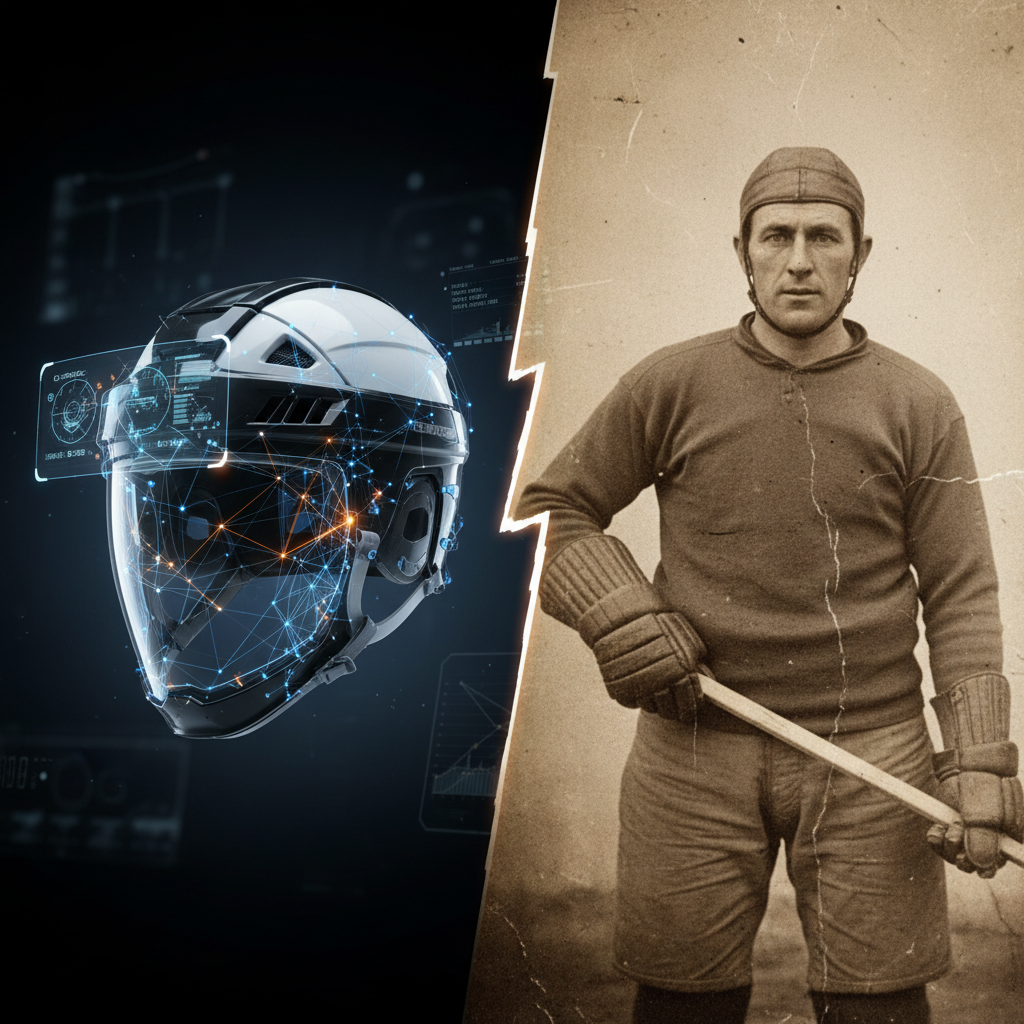
TL;DR: Modern ice hockey, a sport known for its intensity, has seen remarkable advancements in player safety. This article explores how material science, sensor technology, and data analytics have transformed protective gear and injury prevention protocols, moving far beyond the rudimentary equipment of the past, exemplified by the tragic career-ending injury of Ace Bailey.
The Unforgiving Ice: A Historical Perspective on Player Safety
Ice hockey, with its high speeds, hard surfaces, and intense physical contact, has always presented a unique set of safety challenges. For much of its early history, the sport was characterized by minimal protection, relying heavily on the players' resilience. A stark reminder of these dangers came in 1933, when Toronto Maple Leafs forward Ace Bailey suffered a severe head injury from a collision with Boston Bruins defenseman Eddie Shore. The incident, which nearly ended Bailey's life and certainly his career, sent shockwaves through the hockey world, prompting an all-star benefit game and an early, albeit limited, focus on player safety. While Bailey's injury didn't immediately lead to widespread equipment overhauls, it served as a poignant historical marker, highlighting the inherent vulnerabilities of athletes in contact sports and foreshadowing a future where technology would play a crucial role in mitigating such risks.
The Early Game: Raw Courage and Rudimentary Protection
In the nascent days of professional hockey, protective gear was sparse and primitive. Players often wore simple leather pads, if any, and helmets were virtually unheard of. The prevailing ethos prioritized toughness and skill over personal safety, a mindset that, while romanticized, came with significant consequences. Skates were heavy, sticks were wooden, and the boards surrounding the rink offered little give. It was an era where injuries were an accepted, almost expected, part of the game, and the medical understanding of their long-term effects, particularly concussions, was severely limited. This environment set the stage for a slow but inevitable evolution in how the sport approached player welfare.
A New Era of Materials: The Helmet Revolution
The mid-20th century marked the beginning of a significant shift, driven by advancements in materials science. The introduction of the first rudimentary helmets, often made of fiberglass or early plastics, offered a basic level of protection, primarily against cuts and fractures. However, the true revolution began with the understanding of energy dissipation. Modern hockey helmets are sophisticated pieces of equipment, featuring multi-layered designs that combine rigid outer shells, typically made from polycarbonate, with various types of energy-absorbing foams. Materials like expanded polypropylene (EPP) and vinyl nitrile (VN) foam are strategically placed to manage both linear and rotational forces resulting from impacts. These foams are engineered to compress and rebound, effectively distributing and reducing the peak forces transmitted to the player's head. Advanced manufacturing techniques, including injection molding and composite layering, allow for precise control over helmet geometry and material integration, optimizing protection without unduly increasing weight or compromising visibility.
Beyond Basic Padding: Smart Gear and Sensors
The turn of the millennium ushered in an era where protective gear became 'smart.' The integration of micro-sensors into helmets, mouthguards, and other equipment has transformed how impacts are measured and understood. Accelerometers and gyroscopes, miniaturized and robust, are now capable of precisely measuring the linear and rotational acceleration experienced by a player's head during a collision. These sensors collect data on impact location, magnitude, and duration, providing an objective, quantifiable record of forces that were once only subjectively estimated. This real-time or near-real-time data collection is crucial for understanding the mechanics of head impacts, identifying high-risk scenarios, and informing immediate medical assessments.
Data-Driven Decisions: Analytics for Prevention
Collecting raw sensor data is only the first step; its true value lies in robust analysis. Data analytics platforms now process vast amounts of impact data gathered from practices and games. This allows teams, leagues, and equipment manufacturers to identify patterns, such as the most common types of collisions, the areas of the head most frequently impacted, and the force thresholds associated with different injury severities. Machine learning algorithms are increasingly employed to sift through this data, identifying subtle correlations and even predicting potential injury risks based on accumulated impact profiles. This data-driven approach directly informs equipment redesigns, leading to helmets with enhanced protection in vulnerable areas, and influences rule changes aimed at reducing dangerous plays, such as stricter penalties for head contact or checking from behind. The goal is to move from reactive measures to proactive prevention, using insights derived from data to make the game safer.
Concussion Management: A Tech-Aided Approach
Beyond prevention, technology has also significantly advanced the diagnosis and management of concussions. While no technology can definitively diagnose a concussion on its own, various tools aid in objective assessment. Baseline neurocognitive testing, often conducted digitally, provides a benchmark of a player's normal cognitive function, against which post-injury performance can be compared. Advanced eye-tracking systems and balance assessment tools offer objective metrics that can indicate neurological impairment. These technologies, combined with clinical evaluation, help medical staff make more informed decisions about a player's return-to-play protocol, ensuring that athletes are not rushed back into action before they have fully recovered, thereby reducing the risk of further, more severe injury.
The Horizon: Future Innovations in Player Safety
The quest for enhanced player safety is ongoing, with new technologies constantly emerging. Future innovations are likely to include smart materials that can dynamically stiffen or soften in response to impact, offering adaptive protection. Real-time feedback systems could alert players or coaching staff to dangerous impacts as they occur, allowing for immediate assessment. Further advancements in sophisticated digital analysis of impacts will lead to even more personalized protective gear, custom-fitted and designed based on individual player data and playing style. The integration of artificial intelligence for predictive modeling of injury risk, considering factors beyond just impact data, is also a promising area, aiming to create an even safer environment for athletes.
Conclusion
From the tragic lessons of incidents like Ace Bailey's career-ending injury to the cutting-edge innovations of today, the evolution of player safety in ice hockey is a testament to the power of technological advancement. What began as rudimentary protection has transformed into a sophisticated ecosystem of advanced materials, intelligent sensors, and powerful data analytics. This journey reflects an enduring commitment to athlete welfare, demonstrating how technology can not only enhance performance but, more importantly, safeguard the health and careers of those who play the game. The pursuit of safety is a continuous endeavor, ensuring that the thrill of hockey can be enjoyed with ever-increasing confidence in player protection.