TL;DR
- Sustainable software beats quick fixes: Prioritize robust foundations over flashy, short-term 'wins' to avoid long-term pain.
- Technical debt is a silent killer: Rushing development without a plan creates hidden costs that cripple future innovation and speed.
- Strategic MVP is key: Build a valuable Minimum Viable Product with an eye on future scalability, not just the minimum possible.
- Modular architecture mitigates risk: Deconstruct complex systems into independent services for easier maintenance, scaling, and resilience.
- Long-term thinking reduces TCO: Investing in quality engineering upfront leads to lower operational costs and faster feature delivery over time.
Introduction
Every startup founder dreams of a 'win' – a successful launch, rapid user acquisition, a game-changing feature that goes viral. The pressure to deliver quickly, to show traction, and to impress investors is immense. In this high-stakes environment, it's easy to fall into the trap of prioritizing speed and perceived immediate 'wins' over the foundational engineering required for sustainable growth. This 'win now, worry later' mentality, while seemingly aggressive and confident, often leads to a chaotic, unmanageable software system that ultimately undermines the very success it sought to achieve.
Think of it like a charismatic public figure known for their bold declarations of 'winning' and 'tiger blood' – full of immediate impact, but often lacking the underlying stability and long-term strategy to maintain that success. In software, this translates to systems built on shaky ground, where every new feature feels like a heroic battle against a crumbling codebase, and scaling becomes a nightmare. For startup founders, product managers, and technical decision-makers, understanding this dynamic is crucial. Your software isn't just a product; it's the engine of your business. If that engine is built for a sprint but not a marathon, you'll eventually break down.
The Allure of 'Tiger Blood' Engineering
In the startup world, the drive for speed is paramount. There's a constant whisper: 'Launch fast, iterate faster.' This often translates into a development approach that prioritizes getting something out the door over getting the right thing built the right way. The allure of 'tiger blood' engineering is intoxicating: quick hacks, skipping documentation, minimal testing, relying on a single 'rockstar' developer to magic solutions into existence. It feels like winning. You're shipping code, hitting deadlines, showing progress.
This approach often manifests as choosing the trendiest technology without fully understanding its long-term implications, or building a monolithic application where every component is tightly coupled. Decisions are made for immediate gratification, not future resilience. Founders might push for features that aren't truly core to the MVP, or demand integrations that add complexity without proportional value, all in the name of a perceived competitive 'win.'
The Price of Unchecked Velocity: Technical Debt and Burnout
While the 'tiger blood' approach might deliver initial velocity, it invariably accumulates technical debt. For the uninitiated, technical debt isn't just 'bad code'; it's the implied cost of future rework necessary to fix problems caused by choosing an easy solution now instead of a better approach that would take longer. It's like taking out a high-interest loan on your codebase.
Initially, this debt is invisible. But as your product grows, as more features are added, and as more users come on board, that debt compounds. Development slows to a crawl because every change risks breaking something else. Bugs become more frequent and harder to diagnose. Onboarding new developers becomes a nightmare as they navigate an undocumented, spaghetti-code mess. Your team burns out from constant firefighting, and innovation grinds to a halt. This isn't winning; it's a slow, painful defeat, often leading to missed market opportunities, lost revenue, and a reputation for instability.
Engineering for Harmony: Building a Resilient Foundation
The alternative to 'tiger blood' engineering is a strategic, sustainable approach. This means building software with an eye towards longevity, scalability, and maintainability from day one. It's about engineering for harmony – where components work together seamlessly, where changes are predictable, and where your system can evolve without constant, existential crises. This isn't about being slow; it's about being deliberate and efficient in the long run.
This approach emphasizes clear requirements, well-defined architecture, robust testing, and a culture of continuous improvement. It means making informed technology choices, understanding the trade-offs, and investing in developer tooling and processes that support high-quality output. For a startup, this translates directly into reduced operational risk, lower total cost of ownership (TCO), and the ability to pivot and innovate rapidly when market conditions demand it – true business agility.
The MVP Done Right: Strategic Scope, Not Minimal Effort
An MVP (Minimum Viable Product) is crucial for startups, but its definition is often misinterpreted. It's not about building the absolute minimum amount of code to launch; it's about building the most valuable core functionality that solves a key problem for your target users, while laying a robust foundation for future growth. A 'strategic MVP' avoids cutting corners on architecture or security, even if it means deferring some non-essential features.
Here’s a step-by-step process for building a strategic MVP:
- Define the Core Problem and Solution: Ruthlessly identify the single most important problem your product solves and the simplest way to solve it. Avoid feature creep from the outset.
- Identify Critical User Journeys: Map out the essential paths users will take to achieve their primary goal. Focus engineering efforts on making these journeys smooth, reliable, and performant.
- Design Modular Architecture: Even for an MVP, plan for modularity. Think about how different parts of your system will interact and how they might scale independently. This doesn't necessarily mean microservices from day one, but it means clear separation of concerns within your codebase.
- Prioritize Robust Testing: Implement automated tests (unit, integration, end-to-end) for your core functionalities. This provides a safety net as you iterate and reduces the risk of introducing regressions.
- Plan for Iterative Growth: Design your system with extensibility in mind. What's the next logical feature? How can your current architecture accommodate it without a complete rewrite? This foresight prevents future bottlenecks.
Architecture for Longevity: Avoiding the Single Point of Failure
One of the hallmarks of sustainable software is an architecture that minimizes single points of failure and allows for independent evolution. While a monolithic application can be perfectly fine for an MVP, designing it with clear boundaries and modularity is key. As your product grows, this foresight makes transitioning to a more distributed system (like microservices) much smoother, or simply keeps a well-structured monolith manageable.
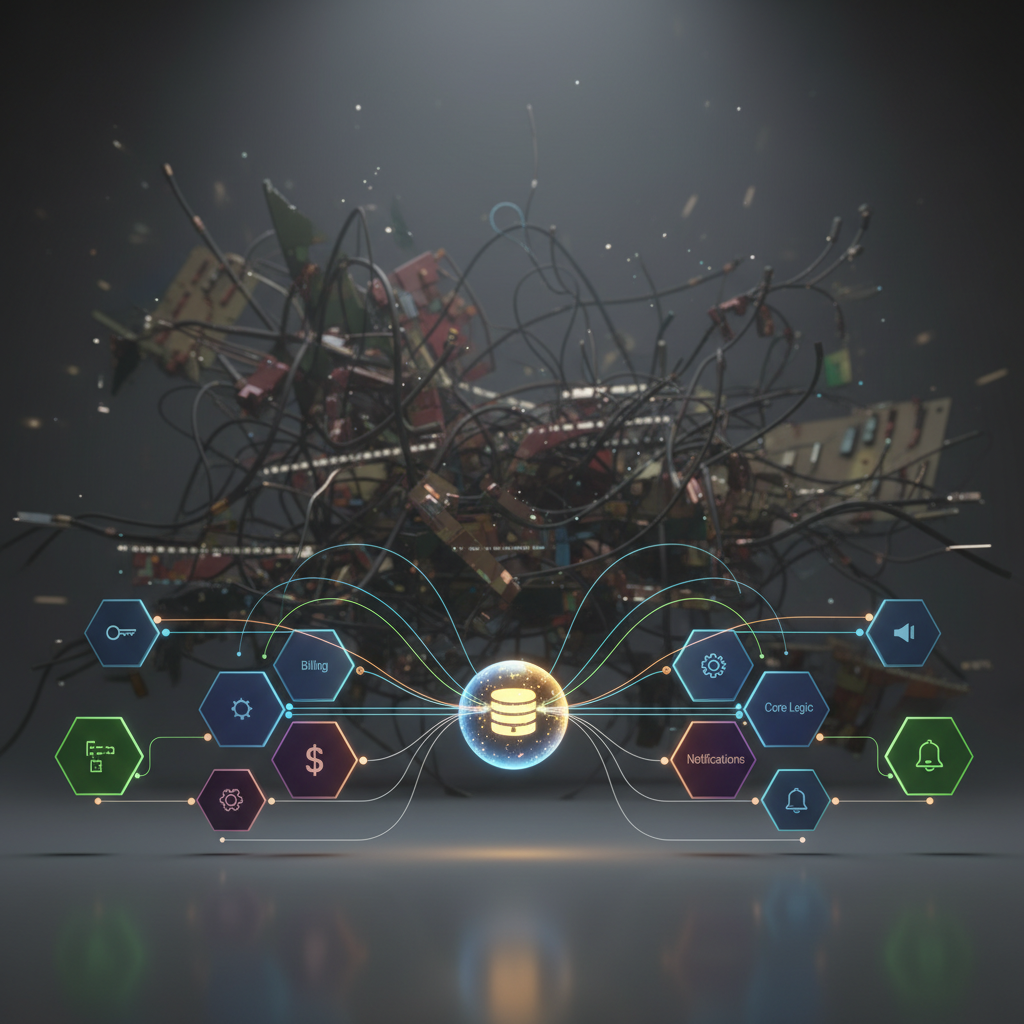
Consider a typical SaaS platform. Instead of a monolithic 'god' service handling everything, we often break it down into logical, independent services or modules, even within a single codebase. For example:
User Authentication Module/Service: Handles user login, registration, and role management.Billing Module/Service: Integrates with payment gateways (e.g., Stripe), manages subscriptions, and handles invoicing.Core Business Logic Module/Service: Contains the unique value proposition and primary operations of your product.Notification Module/Service: Manages sending emails, SMS, or push notifications.Data Storage: A well-structured database (e.g., PostgreSQL) with clear schema definitions, accessed through dedicated data access layers rather than directly from every part of the application.
This separation allows teams to work on different parts of the system without constantly stepping on each other's toes, reduces the blast radius of failures (a bug in notifications won't bring down user auth), and makes scaling specific parts easier without rewriting the entire application. Here's a simplified pseudo-code example illustrating the difference between a tightly coupled approach and a more modular one for processing an order:
// Tightly Coupled/Monolithic Approach (simplified)
function processOrder(orderData) {
    // Direct calls to various functionalities without clear separation
    validateOrder(orderData);
    deductInventory(orderData.items);
    processPayment(orderData.paymentInfo);
    sendConfirmationEmail(orderData.userEmail);
    updateOrderStatus(orderData.id, "completed");
}

// Modular Approach (simplified)
// Services/Modules are injected or accessed through well-defined interfaces
class OrderProcessor {
    constructor(inventoryService, paymentService, notificationService, orderRepository) {
        this.inventoryService = inventoryService; // Dependency Injection
        this.paymentService = paymentService;
        this.notificationService = notificationService;
        this.orderRepository = orderRepository; // Handles database interactions
    }

    async processOrder(orderData) {
        // Validation typically handled by a dedicated validation layer or DTOs before reaching here
        await this.inventoryService.deduct(orderData.items);
        await this.paymentService.process(orderData.paymentInfo);
        await this.notificationService.sendEmail(orderData.userEmail, "Order Confirmed");
        await this.orderRepository.updateStatus(orderData.id, "completed");
    }
}
In the modular approach, OrderProcessor doesn't know how inventory is deducted or payment is processed; it just knows that it can call inventoryService.deduct() and paymentService.process(). This abstraction makes the system more robust, easier to test, and significantly more adaptable to changes in underlying implementations.
The Long Game: Why Sustainable Engineering Pays Off
While the initial investment in sustainable engineering might seem higher, the returns in the long run are undeniable. Businesses built on robust software experience:
- Faster, Predictable Feature Delivery: With less technical debt and a modular codebase, new features can be developed and deployed more quickly and with fewer unexpected issues.
- Reduced Operational Costs: Fewer bugs mean less time spent on firefighting, lower support costs, and more stable infrastructure, directly impacting your bottom line.
- Improved Developer Morale: Engineers prefer working on well-structured, maintainable codebases. This reduces turnover and attracts top talent.
- Higher Customer Satisfaction: A stable, performant product with fewer bugs translates directly into a better user experience, leading to happier customers and stronger retention.
- Easier to Attract Investment: Investors increasingly scrutinize a startup's technical foundation. A well-engineered platform demonstrates maturity and reduces perceived risk.
This isn't just about 'good code'; it's about good business. It's about reducing your total cost of ownership, accelerating your true time-to-market for valuable features, and building a foundation that can withstand the unpredictable demands of growth and market shifts.
Mitigating Risk: From 'Winning' to 'Thriving'
Sustainable engineering is fundamentally about risk mitigation. A poorly built system introduces numerous risks: security vulnerabilities, data loss, performance bottlenecks that drive users away, and the existential risk of being unable to adapt to market changes. By investing in a well-architected, thoroughly tested, and maintainable codebase, you significantly reduce these threats.
You move from a state of constantly 'winning' small battles against your own software to a state where your software reliably supports your business, allowing you to focus on strategy, innovation, and truly thriving. It's the difference between a business constantly in crisis mode and one that operates smoothly, poised for genuine, long-term success.
Key Takeaways
- Avoid the 'win now, worry later' trap; it's a fast track to technical debt and operational chaos.
- Prioritize a strategic MVP that builds a solid foundation, not just the bare minimum.
- Embrace modular architecture and robust testing for scalability and maintainability.
- Sustainable engineering reduces long-term costs, accelerates true innovation, and mitigates business risk.
- Your software is your business's engine; build it for a marathon, not just a sprint.
At PolarSoftBD, we understand the pressures startups face. We specialize in building custom software – from SaaS platforms and CRM systems to Stripe integrations and MVPs – with a focus on sustainable engineering. We help founders and product managers make strategic technical decisions that lead to robust, scalable solutions designed for long-term success, not just fleeting 'wins'.