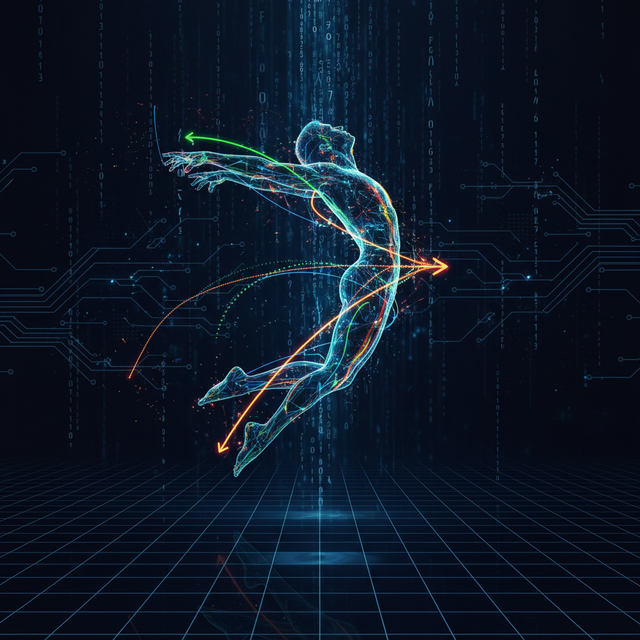
TL;DR: Understanding complex human movement is crucial across many domains. This article explores the sophisticated technologies—from advanced motion capture systems to intricate biomechanical modeling—that enable us to deconstruct dynamic actions. We discuss the computational hurdles in processing vast datasets and transforming raw movement into actionable kinematic and kinetic insights, highlighting applications beyond traditional sports analysis, such as robotics and medical rehabilitation.
The Dance of Data: Decoding Dynamic Movement
The human body in motion is a marvel of biomechanical engineering. From the subtle gestures of daily life to the explosive power of an elite athlete, every movement is a complex interplay of skeletal structure, muscular force, and neurological command. For engineers and researchers, capturing and understanding these dynamics presents a fascinating, multi-faceted challenge. How do we accurately record, process, and interpret the intricate kinematics of a human body executing a high-speed, multi-joint action?
Consider the unparalleled athleticism of an individual like Aaron Gordon, renowned for his gravity-defying dunks and versatile play on the basketball court. His movements are not just powerful; they are precise, adaptive, and highly dynamic. Analyzing such complex actions requires more than just video playback; it demands a deep dive into the underlying data generated by sophisticated motion capture and analysis systems. This exploration takes us into the realm of advanced sensor technology, computational biomechanics, and robust data processing pipelines.
Capturing the Unseen: Evolution of Motion Capture
The journey to understanding human movement often begins with motion capture (MoCap). Early systems were rudimentary, but modern MoCap has evolved into a highly precise science, employing various methodologies:
Optical Motion Capture
This is perhaps the most recognized form, utilizing multiple high-speed cameras to track reflective markers placed at key anatomical landmarks on a subject. Each camera records the 2D position of the markers, and sophisticated triangulation algorithms combine these views to reconstruct the markers' 3D positions in space. The precision of these systems can be astounding, capturing movements at hundreds or even thousands of frames per second, essential for analyzing rapid actions. The raw output is a cloud of 3D points over time, representing the skeletal structure's movement.
Inertial Measurement Units (IMUs)
IMU-based systems offer a portable alternative. These small sensors, containing accelerometers, gyroscopes, and magnetometers, are strapped directly to body segments. They measure linear acceleration, angular velocity, and orientation relative to the Earth's magnetic field. While offering greater flexibility and less reliance on line-of-sight, IMU data requires complex sensor fusion algorithms to mitigate drift and accurately reconstruct full-body kinematics. This approach is particularly valuable for field-based analysis where optical systems are impractical.
Markerless Motion Capture
The frontier of MoCap technology lies in markerless systems, which leverage advanced computer vision and machine learning. These systems analyze standard video footage, identifying human poses and segmenting body parts without the need for physical markers. Techniques like pose estimation (e.g., OpenPose, MediaPipe) use deep neural networks trained on vast datasets of human images to predict 2D or 3D joint locations. While offering unprecedented ease of use, markerless systems currently face challenges in accuracy and robustness compared to marker-based optical systems, especially in occluded or rapidly changing environments. However, their potential for widespread application is immense.
From Points to Principles: Biomechanical Modeling
Raw motion capture data, whether from optical markers or IMUs, is just the starting point. To derive meaningful insights, this data must be fed into biomechanical models. These computational models represent the human body as a series of rigid segments connected by joints, each with defined degrees of freedom.
Kinematics and Kinetics
The first step is often kinematic analysis, which describes the motion of the body without considering the forces causing it. This involves calculating joint angles, angular velocities, and linear velocities and accelerations of body segments. For instance, in a dunk, understanding the precise angles of the knee, hip, and ankle joints at takeoff, and their angular velocities during the jump, provides critical insights into the movement pattern.
Beyond kinematics lies kinetic analysis, which delves into the forces and moments acting on the body. This often requires additional data from force plates (to measure ground reaction forces) or electromyography (EMG) sensors (to measure muscle activity). Using inverse dynamics, engineers can work backward from measured motion and external forces to estimate internal joint forces and muscle moments. This is crucial for understanding the loads on joints, identifying potential injury risks, or optimizing force generation.
Digital Twins and Simulation
The culmination of this modeling effort can lead to the creation of a "digital twin" of the human body or specific limbs. This virtual representation can be used for simulation, allowing researchers to explore "what-if" scenarios without physical risk. For example, simulating how a slight change in foot placement might alter joint loading during a landing, or how different muscle activation patterns affect jump height. Such simulations are computationally intensive, relying on complex physics engines and finite element analysis (FEA) to accurately model tissue deformation and stress distribution.
The Computational Gauntlet: Data Processing Challenges
The sheer volume and complexity of motion capture data present significant computational challenges:
- Data Volume: High-speed optical systems can generate gigabytes of data per minute, requiring robust storage and high-throughput processing pipelines.
- Noise and Artifacts: Raw data is rarely perfect. Marker occlusions, sensor drift, and environmental interference introduce noise that must be filtered and cleaned using sophisticated signal processing algorithms (e.g., Kalman filters, Butterworth filters).
- Synchronization: Integrating data from multiple sources (cameras, IMUs, force plates, EMG) requires precise time synchronization, often down to milliseconds, to ensure accurate correlation of events.
- Real-time Processing: For applications requiring immediate feedback, such as interactive training or robotic control, real-time kinematic and kinetic analysis is paramount, pushing the boundaries of computational efficiency.
- Inverse Problem Complexity: Inverse dynamics, in particular, is an ill-posed problem. There are often more unknown internal forces than measurable external forces, requiring optimization algorithms and simplifying assumptions to find plausible solutions.
Beyond the Court: Broadening Applications
While the example of an athlete like Aaron Gordon vividly illustrates the dynamic nature of human movement, the technologies discussed have profound implications far beyond sports analysis.
- Robotics and Human-Robot Interaction: Understanding human kinematics is fundamental for designing robots that can mimic human movements or interact safely and naturally with people. This includes developing prosthetics that move more organically or industrial robots that can learn complex tasks by observing human operators.
- Animation and Virtual Reality: The entertainment industry relies heavily on motion capture for realistic character animation in films, video games, and virtual reality experiences, bringing digital characters to life with unprecedented fidelity.
- Rehabilitation and Clinical Assessment: In medicine, these systems aid in diagnosing gait disorders, assessing recovery from injuries, and designing personalized rehabilitation programs. By quantifying movement deviations, clinicians can objectively track progress and tailor interventions.
- Ergonomics and Product Design: Engineers use motion analysis to optimize workstation layouts, design safer tools, and improve the ergonomics of products, reducing the risk of musculoskeletal injuries in various industries.
- Aerospace and Defense: Analyzing pilot movements in cockpits or soldier movements in combat scenarios can lead to improved interface design, training protocols, and equipment.
The Future of Movement Analysis: Predictive and Proactive
The trajectory of movement analysis points towards even more sophisticated, predictive, and proactive systems. The integration of advanced machine learning models will enable systems to not only describe movement but also predict future states or identify subtle deviations that might lead to issues. The concept of a personalized digital twin, continuously updated with an individual's movement data, could become a powerful tool for personalized health, training, and even interactive virtual experiences. Ethical considerations around data privacy and the potential for misuse of such detailed personal information will also become increasingly important.
Conclusion
From the intricate mechanics of a high-flying dunk to the precise movements required for surgical procedures, the ability to accurately capture, model, and analyze human motion is a cornerstone of modern technological advancement. The fusion of high-fidelity sensor technology, robust computational biomechanics, and intelligent data processing continues to push the boundaries of what we can understand about ourselves and how we interact with the physical world. As these technologies mature, their impact will undoubtedly resonate across an ever-widening spectrum of engineering and scientific disciplines, transforming how we design, interact, and innovate.