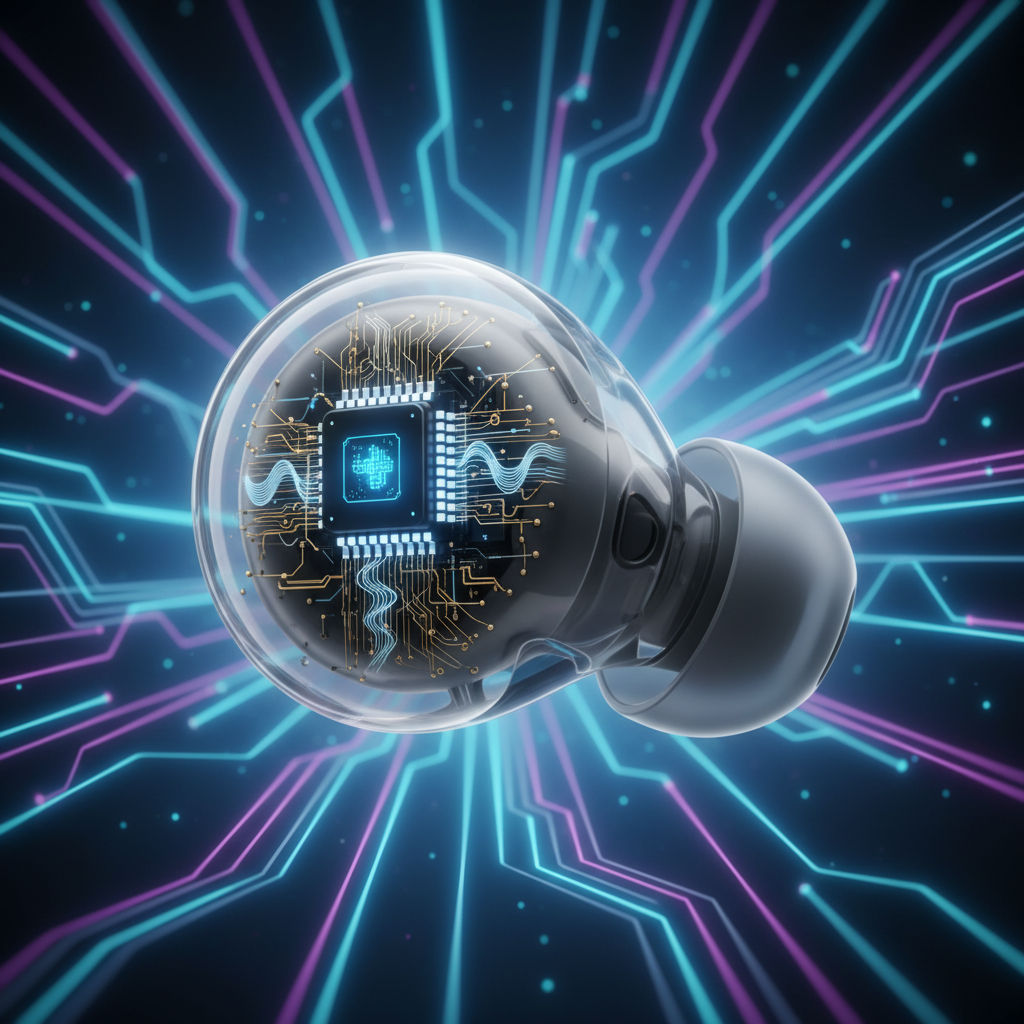
TL;DR: The hypothetical next iteration of premium wireless earbuds, often anticipated as "AirPods Pro 3," represents a significant engineering undertaking. This article explores the core technical advancements required, focusing on ultra-efficient System-in-Package (SiP) designs for enhanced computational audio, sophisticated algorithms for personalized spatial audio and adaptive noise management, the integration of advanced sensor arrays for new user interactions and potential health insights, and breakthroughs in low-power wireless connectivity. We delve into how these intertwined engineering disciplines push the boundaries of miniaturization, acoustic fidelity, and intelligent user experience in a tiny form factor.
The landscape of personal audio has undergone a profound transformation, with wireless earbuds evolving from simple audio output devices into sophisticated computational platforms. Apple's AirPods Pro series has consistently pushed the envelope, setting high benchmarks for active noise cancellation (ANC), transparency, and spatial audio. As the industry anticipates the next leap, often dubbed "AirPods Pro 3," the engineering challenges and opportunities become even more intricate. This isn't merely about incremental updates; it's about redefining what's possible within a miniaturized, power-constrained form factor. For engineers at PolarSoftBD, understanding these deep technical hurdles and innovations is key to appreciating the future direction of embedded systems and user-centric design.
The Silicon Heartbeat: Advancements in System-in-Package (SiP) Design
At the core of any advanced wearable lies its custom silicon. For a device like the next-generation AirPods Pro, the System-in-Package (SiP) approach is paramount. This involves integrating multiple semiconductor dies—including the main audio processor, memory, power management units, and wireless communication modules—into a single, compact package. The "H-series" chips, custom-designed by Apple, are exemplary in this regard. For a hypothetical "Pro 3," we anticipate an even more powerful, yet more power-efficient, iteration.
This next-gen SiP would likely feature an upgraded neural engine, crucial for accelerating on-device machine learning tasks. These tasks range from real-time audio analysis for adaptive noise cancellation to processing sensor data for personalized spatial audio and potential new health-related features. The engineering challenge lies in maximizing computational throughput while minimizing power consumption and heat generation within an incredibly confined space. Innovations in die stacking, advanced packaging techniques, and heterogeneous computing architectures will be vital to achieve the necessary performance gains without compromising battery life or physical dimensions. This custom silicon is the foundation upon which all other advanced features are built, enabling a seamless and intelligent user experience that off-the-shelf components simply cannot match.
Mastering Soundscapes: Next-Gen Audio Algorithms
The true magic of premium earbuds often lies not just in their hardware, but in the sophisticated digital signal processing (DSP) and machine learning algorithms that shape the audio experience. For the "AirPods Pro 3," we expect significant leaps in computational audio.
Adaptive Noise Control: While current ANC is impressive, future iterations could leverage more advanced real-time environmental analysis. Imagine an adaptive noise control system that doesn't just block sound, but intelligently filters specific frequencies based on the user's immediate surroundings and preferences, perhaps even learning over time. This would involve more powerful microphones, faster DSP, and sophisticated AI models running on the SiP to classify ambient sounds and apply highly targeted inverse sound waves.
Personalized Spatial Audio: Spatial Audio with dynamic head tracking has revolutionized immersive listening. For the next generation, personalization is key. This could involve using on-device sensors to map the user's ear canal acoustics or head shape, creating a truly bespoke audio profile that optimizes the spatialization for their unique physiology. The algorithms would need to dynamically adjust the sound field, accounting for head movements with even greater precision and lower latency, creating an even more convincing three-dimensional soundstage. This level of personalization requires significant computational power and finely tuned acoustic models.
Beyond Listening: Integrated Sensor Architectures
Modern earbuds are no longer just about sound; they are sophisticated sensor hubs. The "AirPods Pro 3" could push these capabilities further, transforming the device into an even more integral part of a user's digital and physical life.
Enhanced User Interaction: Force sensors and accelerometers already enable intuitive controls. Future iterations might integrate more advanced haptic feedback systems or even subtle gesture recognition capabilities, allowing for touchless interactions. Imagine subtle head nods or shakes to accept/reject calls, processed by on-device machine learning models interpreting micro-movements from accelerometers and gyroscopes.
Contextual Awareness: Integrating additional environmental sensors, such as temperature or even basic air quality sensors, could provide users with more contextual information. While full-fledged health monitoring might be a stretch for a device of this size, the foundation for collecting biometric data (e.g., heart rate through optical sensors or even body temperature via skin contact) could be laid. The engineering challenge here is integrating these diverse sensor types, ensuring their accuracy, managing their power consumption, and securely processing their data on the edge, all while maintaining the compact and comfortable form factor. This multi-sensor fusion creates a richer understanding of the user's environment and state, opening doors for innovative applications.
Seamless Connectivity and Power Efficiency Redefined
Connectivity and battery life are perpetual engineering battlegrounds for wireless devices. The "AirPods Pro 3" would undoubtedly showcase advancements in both areas.
Bluetooth LE Audio: The adoption of Bluetooth LE Audio (Low Energy Audio) is a significant step forward. This standard promises higher audio quality at lower bitrates, reduced latency, and significantly improved power efficiency. For engineers, this means re-optimizing the entire wireless stack, from the antenna design and RF front-end to the codec implementation and firmware. It also enables features like Auracast, allowing a single audio source to broadcast to multiple receivers simultaneously, opening up new shared listening experiences.
Extended Battery Life: While larger batteries are always an option, the real engineering feat lies in achieving extended battery life through systemic efficiencies. This involves optimizing every component: the custom SiP, which is designed for peak performance at minimal power draw; the power management integrated circuits (PMICs) that precisely regulate voltage; and the firmware that intelligently manages power states. Even the charging case could see innovations, perhaps offering faster charging speeds or even reverse wireless charging capabilities, allowing it to draw power from a compatible iPhone. The goal is to deliver all the new features without compromising the convenience of all-day use.
The Future of Wearable Audio Engineering
The journey from basic earbuds to sophisticated, intelligent personal audio devices is a testament to relentless engineering innovation. The hypothetical "AirPods Pro 3" represents not just an evolution in consumer electronics, but a microcosm of broader trends in embedded systems, AI/ML at the edge, and human-computer interaction.
The challenges are immense: balancing miniaturization with performance, power efficiency with feature density, and acoustic fidelity with computational complexity. Yet, it is precisely these constraints that drive groundbreaking solutions in custom silicon design, advanced material science, sophisticated algorithm development, and seamless software integration. As engineers, we look forward to seeing how these frontiers are pushed, shaping an even more immersive, personalized, and intelligent future for how we experience sound and interact with our digital world. The next generation of wearable sound will undoubtedly be a marvel of integrated engineering.