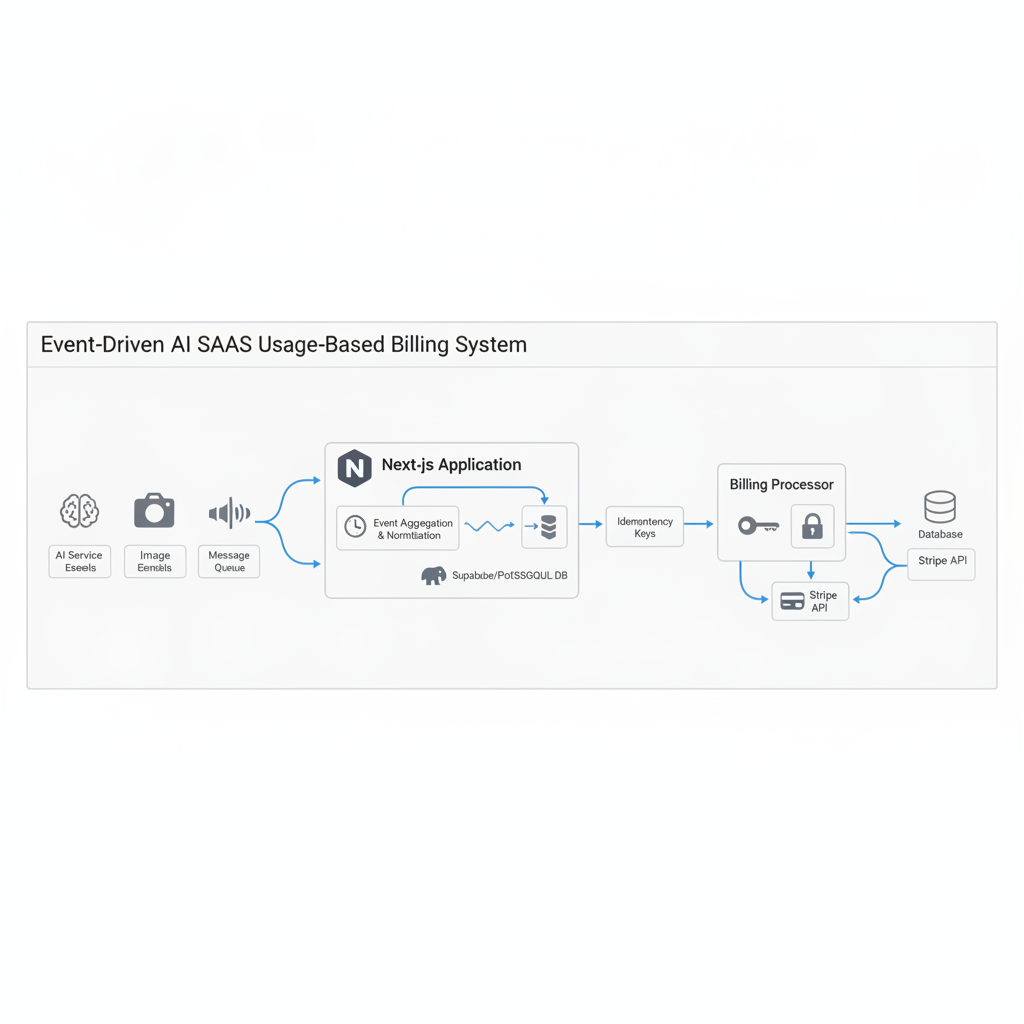
The Problem: Monetizing Dynamic AI Usage in Production
If you're a technical founder or CTO building an AI SaaS product, you've likely encountered the headache of monetizing AI usage when the underlying model costs are a moving target. The AI landscape is evolving at breakneck speed, with new models, varying pricing structures (per token, per image, per compute second), and frequent updates from providers like OpenAI, Anthropic, or specialized APIs. Simply charging a flat fee often leads to either underpricing your service or overcharging your users, neither of which is sustainable.
The core problem is this: how do you implement a robust, scalable, and accurate usage-based billing system that can adapt to dynamic AI costs, track diverse usage metrics across different models, and integrate seamlessly with a payment provider like Stripe, all within a production-grade Next.js application? Generic solutions often fall short, leaving you vulnerable to billing errors, revenue leakage, or frustrated customers. This guide will walk you through building such a system, focusing on the production edge cases that separate a toy project from a reliable AI SaaS platform.
TL;DR
- Dynamic AI Costs: Build for flexibility to accommodate varying and changing AI model pricing.
- Event-Driven Tracking: Implement an event-driven system for granular usage data capture.
- Stripe Metered Billing: Leverage Stripe's usage records API for accurate, scalable billing.
- Next.js Integration: Use Next.js API routes for secure, server-side usage reporting.
- Production Robustness: Prioritize idempotency, webhook reliability, and race condition handling.
The Challenge of AI Usage Tracking
AI usage isn't monolithic. A single user might generate text with GPT-4, create images with DALL-E, and transcribe audio with Whisper, all within minutes. Each of these actions consumes different resources, incurs different costs from your upstream providers, and needs to be tracked with varying metrics:
- Tokens: For large language models (LLMs), typically input and output tokens.
- Images: Per image generated, often with variations for resolution or quality.
- Compute Time: For more complex or custom models, billed by the second or minute.
- API Calls: Sometimes a simpler metric, but less granular for cost pass-through.
Your system must capture these disparate metrics, associate them with the correct user and subscription, and translate them into billable units for your pricing model. This requires a robust data model and an efficient way to aggregate usage in near real-time.
Architecting for Scalability and Accuracy
An event-driven architecture is paramount for tracking AI usage. Every significant AI interaction should emit a usage event. This decouples the usage tracking from the core AI processing logic and allows for asynchronous processing, improving performance and resilience.
Usage Event Structure
Each usage event should contain sufficient detail for later aggregation and billing. A typical event might look like this:
interface AiUsageEvent {
  id: string; // Unique event ID for idempotency
  userId: string;
  subscriptionItemId: string; // Stripe subscription item ID
  modelId: string; // e.g., 'gpt-4-turbo', 'dall-e-3'
  eventType: 'tokens_generated' | 'images_created' | 'compute_seconds';
  unitsUsed: number; // e.g., 1000 tokens, 1 image, 3.5 seconds
  costPerUnitAtTimeOfUse: number; // Crucial for dynamic pricing
  currency: string; // e.g., 'usd'
  timestamp: number; // Unix timestamp
  metadata?: Record<string, any>; // Additional context
}
These events should be stored in a durable message queue (e.g., Kafka, RabbitMQ, or a simple database queue for lower scale) before being processed. This ensures that even if your billing service is temporarily down, usage data is not lost.
Database Schema for Aggregation
Your database (e.g., PostgreSQL with Supabase) will need tables to store raw usage events and aggregated usage for reporting to Stripe.
CREATE TABLE ai_usage_events (
  id UUID PRIMARY KEY DEFAULT gen_random_uuid(),
  user_id UUID NOT NULL REFERENCES public.users(id),
  subscription_item_id TEXT NOT NULL, -- Stripe's sub_item_XXX
  model_id TEXT NOT NULL,
  event_type TEXT NOT NULL,
  units_used NUMERIC NOT NULL,
  cost_per_unit_at_time_of_use NUMERIC NOT NULL,
  currency TEXT NOT NULL DEFAULT 'usd',
  timestamp TIMESTAMPTZ NOT NULL DEFAULT now(),
  is_reported_to_stripe BOOLEAN NOT NULL DEFAULT FALSE,
  stripe_usage_record_id TEXT,
  idempotency_key TEXT UNIQUE NOT NULL -- For Stripe API calls
);

-- You might also have a table for current model pricing
CREATE TABLE ai_model_prices (
  model_id TEXT PRIMARY KEY,
  unit_type TEXT NOT NULL, -- e.g., 'token', 'image'
  price_per_unit NUMERIC NOT NULL,
  currency TEXT NOT NULL DEFAULT 'usd',
  last_updated TIMESTAMPTZ NOT NULL DEFAULT now()
);
This schema allows you to track individual events and mark them as reported. The idempotency_key is vital for preventing duplicate reports to Stripe, which we'll discuss in detail.
Integrating with Stripe for Usage-Based Billing
Stripe's Metered Billing functionality is the cornerstone of this system. It allows you to define products and prices where the quantity billed is determined by usage reported over a billing period, rather than a fixed amount.
- Stripe Product Setup: Create a
Productin Stripe for your AI service (e.g., 'AI API Access'). - Stripe Price Setup: For this product, create one or more
Priceswith abilling_schemeofper_unitandrecurring.usage_typeset tometered. Define theunit_amount(your charge per unit) andrecurring.interval(e.g.,month). Crucially, ensurerecurring.aggregate_usageis set tosumorlast_everdepending on your aggregation strategy (typicallysumfor cumulative usage). - Subscription Items: When a user subscribes, Stripe creates a
Subscriptionwith one or moreSubscriptionItems. EachSubscriptionItemcorresponds to aPrice. You'll need theidof the relevantSubscriptionItemwhen reporting usage.
Reporting Usage to Stripe
As users consume AI resources, your backend service (e.g., a Next.js API route or a dedicated worker) aggregates the usage events and reports them to Stripe using the usageRecords.create API. This should happen periodically (e.g., hourly, daily) or immediately after significant usage, depending on your billing granularity requirements.
Next.js Implementation Details
In a Next.js App Router setup, you'll typically have an API route that receives usage events (perhaps from a serverless function triggered by your AI service's completion) or a cron job that processes queued events and reports them to Stripe.
Example: Reporting Usage to Stripe from a Next.js API Route
This example assumes you have a queue worker that processes ai_usage_events from your database and then calls this API route, or a direct call from your AI service (less common due to security concerns).
// app/api/stripe-usage/route.ts
import { NextRequest, NextResponse } from 'next/server';
import Stripe from 'stripe';
import { db } from '@/lib/db'; // Your Supabase/Postgres client

const stripe = new Stripe(process.env.STRIPE_SECRET_KEY!, {
  apiVersion: '2023-10-16',
});

interface ReportUsageRequestBody {
  usageEvents: Array<{
    id: string; // Our internal event ID
    subscriptionItemId: string; // Stripe's sub_item_XXX
    unitsUsed: number;
    timestamp: number; // Unix timestamp
    idempotencyKey: string; // Unique key for Stripe API call
  }>;
}

export async function POST(req: NextRequest) {
  const body: ReportUsageRequestBody = await req.json();
  const { usageEvents } = body;

  if (!usageEvents || usageEvents.length === 0) {
    return NextResponse.json({ error: 'No usage events provided' }, { status: 400 });
  }

  const results: any[] = [];

  for (const event of usageEvents) {
    try {
      const usageRecord = await stripe.subscriptionItems.createUsageRecord(
        event.subscriptionItemId,
        {
          quantity: Math.round(event.unitsUsed), // Stripe expects integers for quantity
          timestamp: event.timestamp, // Unix timestamp in seconds
          action: 'increment', // Add to current usage
        },
        { idempotencyKey: event.idempotencyKey } // Crucial for preventing duplicates
      );

      // Mark the event as reported in your database
      await db.from('ai_usage_events')
        .update({ is_reported_to_stripe: true, stripe_usage_record_id: usageRecord.id })
        .eq('id', event.id);

      results.push({ eventId: event.id, success: true, usageRecordId: usageRecord.id });

    } catch (error: any) {
      console.error(`Failed to report usage for event ${event.id}:`, error);
      // Implement robust error handling, e.g., re-queue event, send alert
      results.push({ eventId: event.id, success: false, error: error.message });
    }
  }

  // Consider if all events failing should return a 500
  const allSucceeded = results.every(r => r.success);
  return NextResponse.json({ results, allSucceeded }, { status: allSucceeded ? 200 : 207 }); // 207 Multi-Status
}
Key considerations for this Next.js API route:
- Security: This route should be protected. If called internally by a worker, use API keys or other authentication. If exposed to a client, this is a dangerous pattern; usage reporting should almost always be server-side.
- Batching: For high-volume systems, batching usage events into a single API call to your backend (which then iterates and calls Stripe) is more efficient than individual calls.
action: 'increment': This is typically what you want for metered billing, adding to the current period's total. If you need to set an exact quantity, useset.quantityas integer: Stripe expects an integer forquantity. If yourunitsUsedare fractional (e.g., 0.5 tokens), you'll need a strategy for rounding or aggregating to whole units before reporting.
Production Edge Cases: Beyond the Happy Path
This is where production payments and AI engineering truly shine. Ignoring these edge cases will lead to incorrect billing, lost revenue, and a poor user experience.
Idempotency: Preventing Duplicate Usage Records
Stripe's idempotency_key is non-negotiable. Network issues, retries, or even accidental double-submissions can cause your system to send the same usage event to Stripe multiple times. Without an idempotency_key, each submission would create a new usage record, leading to overbilling.
- Strategy: Generate a unique
idempotency_keyfor each attempt to report a specific usage event to Stripe. This key should be stored alongside yourai_usage_eventrecord in your database. When retrying a failed Stripe API call, reuse the sameidempotency_key. - Implementation: As shown in the code snippet, pass
{ idempotencyKey: event.idempotencyKey }in the options object tostripe.subscriptionItems.createUsageRecord.
Webhook Retries and Eventual Consistency
Your system will likely consume webhooks (e.g., from Stripe for subscription changes, or from your AI provider for usage confirmations). Webhooks are not guaranteed to be delivered exactly once or in order. They can be delayed, duplicated, or fail.
- Strategy: Design your webhook handlers to be idempotent. Process events based on their unique ID and ensure that processing the same event multiple times has the same outcome as processing it once. Store webhook event IDs to prevent re-processing. Use an event queue for processing webhooks asynchronously.
- Relevance: If your AI provider sends webhooks for confirmed usage, you might use these to update your internal usage records, potentially overriding preliminary estimates.
Race Conditions in Usage Reporting
Multiple concurrent requests from the same user could lead to race conditions if your usage tracking isn't carefully designed. For instance, two AI calls complete almost simultaneously, and both try to update the same usage counter.
- Strategy: The event-driven approach inherently mitigates this for reporting to Stripe, as each
usageRecords.createcall is an atomic increment. However, if you're doing complex aggregations before reporting (e.g., in-memory counters), ensure you use atomic operations, database transactions with proper locking, or rely on an eventually consistent system that can reconcile discrepancies. - Stripe's
action: 'increment': This helps, as Stripe handles the atomic increment on their end for the subscription item.
Security: Protecting Usage Data and API Keys
- API Keys: Never expose your Stripe secret key or AI provider API keys to the client-side. All API calls involving these keys must originate from your secure backend (Next.js API routes or dedicated services).
- Usage Reporting Integrity: Ensure that usage events reported to your backend are authentic. Authenticate requests to your usage reporting API routes. For instance, if your AI service reports usage, it should use an internal API key or token that only your services possess.
- User Data: Handle user-specific usage data with the same care as other sensitive information, adhering to data privacy regulations.
Error Handling and Refund Paths
What happens when an AI call fails after usage has been reported? Or if there's a bug in your tracking?
- Correction: Stripe allows you to update usage records or create negative usage records to correct errors. You can use
createUsageRecordwith a negativequantityoraction: 'set'to adjust the total for the billing period. This requires careful tracking of your internalai_usage_eventsandstripe_usage_record_id. - Refunds/Credits: For more complex scenarios, you might need to issue a credit balance to a customer in Stripe or create a refund. Ensure your system has an administrative interface or a clear process for these manual adjustments.
- Monitoring: Implement robust logging and monitoring for failed usage reports, discrepancies between your internal usage and Stripe's, and any errors during the AI process itself.
Cost Fluctuations and Pricing Model Updates
As AI models evolve, their pricing can change. Your cost_per_unit_at_time_of_use in the ai_usage_events table is crucial here. This ensures that a user is billed based on the cost at the moment they consumed the resource, not at the end of the billing cycle.
- Strategy: Regularly update your
ai_model_pricestable. When an AI request comes in, fetch the currentprice_per_unitand store it with theai_usage_event. For subscription prices, if your baseunit_amountin Stripe changes, you'll need to create a new Price and migrate customers or apply the new price at the start of their next billing cycle.
Key Takeaways
- Granular Tracking is Key: An event-driven approach with detailed
ai_usage_eventsis fundamental for accurate AI usage-based billing. - Stripe is Your Partner: Leverage Stripe's metered billing capabilities, specifically
usageRecords.create, for robust billing. - Next.js for Backend Logic: Securely implement usage reporting via Next.js API routes, keeping sensitive operations server-side.
- Prioritize Production Readiness: Idempotency, robust error handling, and security are not optional; they are critical for a reliable system.
- Adapt to Change: Design your system to handle dynamic AI model costs and evolving pricing structures.
Ship this without the trial-and-error
Building a production-grade AI SaaS platform with complex usage-based billing and secure payment integrations is a specialist challenge. It requires deep expertise in both AI engineering and payments infrastructure. If you're navigating the complexities of multi-tenant architectures, AI credit systems, or robust Stripe integrations, PolarSoftBD has the battle-tested experience to get you to market with confidence.
Don't reinvent the wheel or get stuck on production edge cases. Explore our specialized SaaS Development services to accelerate your AI product launch. We frequently tackle challenges like those discussed here, including advanced usage-based billing with Stripe and Next.js and implementing robust AI credits systems.
Ready to discuss your project? Book a free strategy call with PolarSoftBD today.