- Stripe Connect
- Webhooks
- Next.js
- Multi-tenancy
- Idempotency
- Payments
Securely Managing Stripe Connect Webhooks Across Multiple Accounts in Next.js
Developers building multi-tenant SaaS platforms leveraging Stripe Connect often grapple with the complexity of securely and reliably processing webhooks from both their…
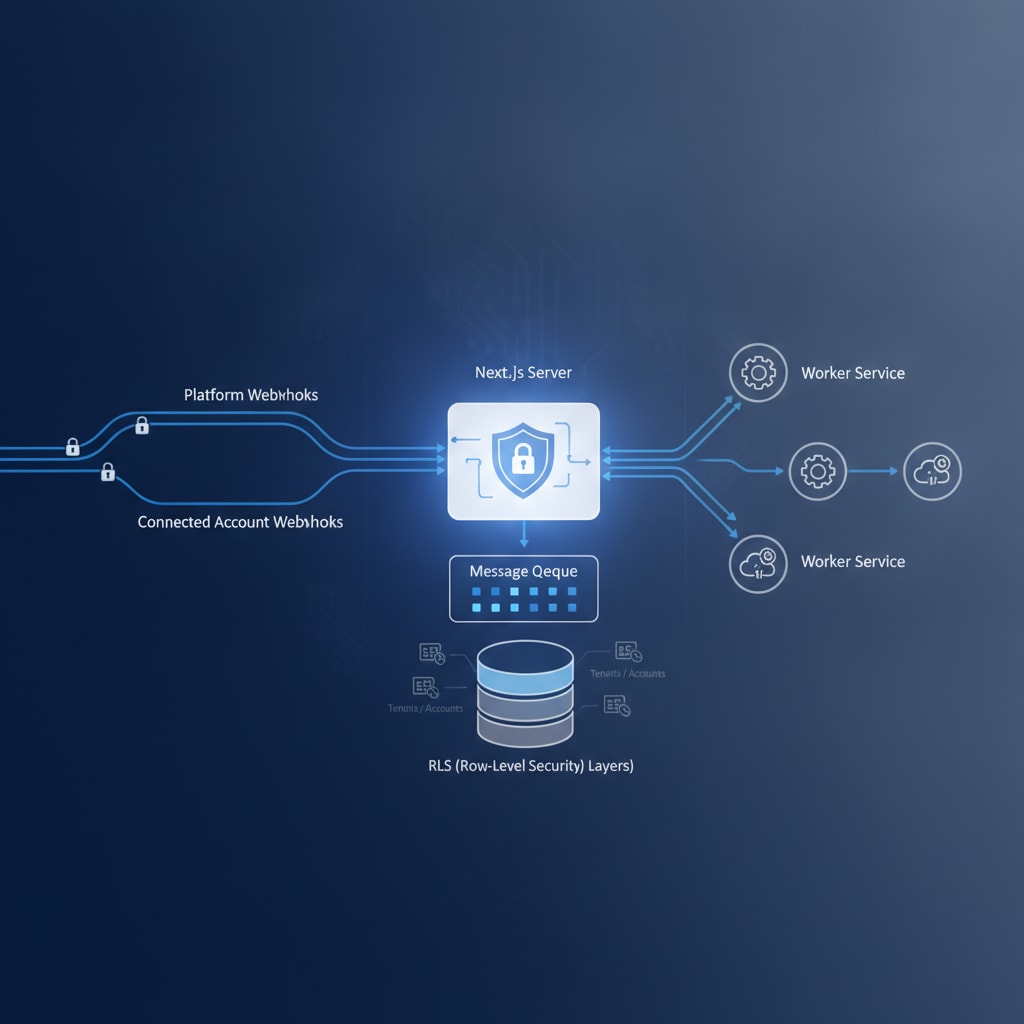
Developers building multi-tenant SaaS platforms leveraging Stripe Connect often grapple with the complexity of securely and reliably processing webhooks from both their platform account and numerous connected accounts within a single Next.js backend. This isn't just about receiving events; it's about distinguishing them, ensuring data integrity across tenant boundaries, and preventing processing errors that lead to financial discrepancies or customer dissatisfaction. If you've found yourself wrestling with duplicate charge.succeeded events, struggling to map a payment_intent.succeeded to the correct connected account, or worrying about the security implications of a shared webhook endpoint, you're not alone. This guide will walk you through building a production-grade webhook architecture for your Stripe Connect marketplace in Next.js.
TL;DR
- Implement distinct webhook endpoints for platform and connected accounts.
- Utilize Stripe's
Stripe-Signatureheader for robust authentication with unique secrets. - Store and check
Stripe-Webhook-Idfor idempotency across all accounts to prevent duplicate processing. - Design a queueing system (e.g., Redis, dedicated message broker) for asynchronous processing to enhance resilience.
- Leverage the
Stripe-Accountheader and Supabase RLS for tenant data isolation during processing.
The Multi-Account Webhook Conundrum
When you operate a Stripe Connect marketplace, your application isn't just dealing with events from your own Stripe platform account (e.g., account.updated, invoice.paid). You're also receiving events from every connected account (e.g., charge.succeeded, transfer.succeeded, payout.paid). Each type of event, originating from different Stripe accounts, often requires different processing logic and impacts different data within your multi-tenant application.
The core challenge lies in securely and reliably distinguishing these events. A naive approach might be to funnel all webhooks to a single endpoint with a single secret. This immediately introduces security vulnerabilities and makes it impossible to correctly verify the origin of an event without complex, error-prone logic. Furthermore, without proper isolation, a charge.succeeded event from one connected account could inadvertently update the balance of another, leading to severe financial discrepancies.
Architecting for Isolation: Dedicated Endpoints
The fundamental step to managing Stripe Connect webhooks effectively is to establish distinct webhook endpoints for your platform account and your connected accounts. This segregation provides clear boundaries for authentication and processing.
Platform Webhooks
Your platform account webhooks should go to a dedicated endpoint, for example, POST /api/webhooks/stripe/platform. This endpoint will listen for events directly related to your platform's Stripe account, such as account.updated (for your own account), customer.created (for customers you manage directly), or invoice.paid (for your own subscriptions). It will use your platform's specific webhook secret for verification.
Connected Account Webhooks
For connected accounts, Stripe provides a powerful mechanism: a single webhook endpoint that receives events from all connected accounts. This endpoint, for example, POST /api/webhooks/stripe/connect, will receive events like charge.succeeded or transfer.created from any of your connected accounts. Crucially, Stripe includes the Stripe-Account header in these requests, which contains the ID of the connected account that sent the event. This header is your key to correctly attributing the event to the right tenant in your system. This endpoint will use a separate, dedicated secret for connected account webhooks, which you configure in your Stripe Connect settings.
Authenticating Webhooks: Beyond the Basics
Verifying the authenticity of a webhook is non-negotiable. Without it, your application is vulnerable to malicious actors sending fake events, potentially triggering fraudulent actions or data corruption. Stripe uses the Stripe-Signature header for this purpose. For a multi-account setup, you'll need to manage multiple secrets.
Each webhook endpoint will have its own secret key. Your platform webhook endpoint will use STRIPE_WEBHOOK_SECRET_PLATFORM, and your connected account webhook endpoint will use STRIPE_WEBHOOK_SECRET_CONNECT. When processing a webhook, you must use the correct secret to verify the signature.
Here's a basic Next.js API route snippet demonstrating how to verify a connected account webhook. The platform webhook verification would follow a very similar pattern, just using its specific secret:
import { NextRequest, NextResponse } from 'next/server';
import Stripe from 'stripe';

const stripe = new Stripe(process.env.STRIPE_SECRET_KEY!, {
  apiVersion: '2023-10-16',
});

const connectWebhookSecret = process.env.STRIPE_WEBHOOK_SECRET_CONNECT!;

export async function POST(req: NextRequest) {
  const rawBody = await req.text();
  const signature = req.headers.get('stripe-signature');
  const stripeAccount = req.headers.get('stripe-account'); // Essential for Connect accounts

  if (!signature || !stripeAccount) {
    return new NextResponse('Missing Stripe-Signature or Stripe-Account header', { status: 400 });
  }

  let event: Stripe.Event;

  try {
    event = stripe.webhooks.constructEvent(
      rawBody,
      signature,
      connectWebhookSecret
    );
  } catch (err: any) {
    console.error(`Webhook signature verification failed for account ${stripeAccount}:`, err.message);
    return new NextResponse(`Webhook Error: ${err.message}`, { status: 400 });
  }

  // Log and queue the event for asynchronous processing
  console.log(`Received Connect webhook for account ${stripeAccount}, event type: ${event.type}`);

  // TODO: Implement robust event queueing here (e.g., to Redis, a dedicated message broker)
  // For now, we'll just acknowledge receipt.
  // await queueWebhookEvent(event, stripeAccount);

  return new NextResponse('Success', { status: 200 });
}
Notice the use of req.text() to get the raw body, which is critical for signature verification, and the extraction of Stripe-Account for later use. This stripeAccount ID is your bridge to identifying the correct tenant in your database.
Ensuring Idempotency: The Stripe-Webhook-Id
Stripe guarantees at-least-once delivery for webhooks, meaning you might receive the same event multiple times. This isn't a bug; it's a feature designed for resilience. However, if your application processes a charge.succeeded event twice, it could incorrectly credit a vendor or update a user's balance twice, leading to financial inconsistencies. Idempotency is crucial.
Every Stripe webhook event includes a unique id. You must store this Stripe-Webhook-Id in your database (e.g., a processed_webhooks table) and check it before processing any event. If the ID already exists, you simply acknowledge the webhook and return a 200 OK without re-processing. This prevents duplicate actions.
CREATE TABLE processed_webhooks (
    id TEXT PRIMARY KEY, -- Corresponds to Stripe.Event.id
    stripe_account_id TEXT, -- Null for platform, actual ID for connect
    event_type TEXT NOT NULL,
    received_at TIMESTAMP WITH TIME ZONE DEFAULT NOW()
);
When an event arrives, your processing logic should first attempt to insert the event.id into this table. If the insert fails due to a primary key conflict, it means the event has already been processed, and you can safely exit. If it succeeds, you proceed with processing. This simple check handles most retry scenarios.
Race conditions can still occur if two identical webhooks arrive almost simultaneously and your idempotency check isn't atomic. To mitigate this, consider using advisory locks in your database if you're processing events immediately, or rely on the inherent atomicity of INSERT ... ON CONFLICT DO NOTHING in PostgreSQL (or similar in other databases) if your processed_webhooks table has a unique constraint on id.
Asynchronous Processing for Resilience
Processing webhooks synchronously within the HTTP request handler is an anti-pattern for production systems. It introduces several risks:
- Timeouts: Complex logic or external API calls can exceed the webhook sender's timeout (Stripe expects a 200 OK within a few seconds), leading to repeated retries from Stripe.
- Failures: An unhandled error during synchronous processing will result in a non-200 response, causing Stripe to retry, potentially exacerbating the issue.
- Scalability: High volumes of webhooks can overwhelm your server.
The best practice is to acknowledge the webhook immediately with a 200 OK after signature verification and then hand off the event to an asynchronous processing queue. Technologies like Redis (e.g., Upstash Redis with a job queue library), AWS SQS, Google Cloud Pub/Sub, or dedicated job queue services like BullMQ can be used. Your Next.js API route simply pushes the raw event data and Stripe-Account ID to the queue, and a separate worker process consumes and processes these events.
This architecture decouples the webhook reception from its processing, making your system more resilient, scalable, and easier to debug. If a worker fails, the message can be retried from the queue without affecting the webhook sender.
Data Isolation in Action: Multi-Tenant Context
For multi-tenant SaaS, ensuring that webhook-triggered updates correctly modify data for the associated tenant is paramount. The Stripe-Account header is your golden ticket for connected account webhooks.
When a connected account webhook is received and queued, ensure the stripeAccount ID is part of the queued payload. Your worker process, upon consuming the event, will use this ID to look up the corresponding tenant in your database. For example, if you have a tenants table with a stripe_connect_account_id column, you can fetch the tenant_id associated with the stripeAccount.
Once you have the tenant_id, all subsequent database operations related to that webhook event must be scoped to that tenant_id. If you're using Supabase, this is where Row Level Security (RLS) becomes incredibly powerful. You can set RLS policies on your tables (e.g., payments, orders, balances) to ensure that your worker can only UPDATE or INSERT rows where tenant_id matches the one derived from the Stripe-Account header. This provides a robust layer of protection against cross-tenant data leakage or corruption.
For example, an RLS policy on a payments table might look like this:
CREATE POLICY "Tenants can view and update their own payments" ON payments
  FOR ALL
  USING (tenant_id = current_setting('app.tenant_id', TRUE)::uuid)
  WITH CHECK (tenant_id = current_setting('app.tenant_id', TRUE)::uuid);
Your worker process would then set the app.tenant_id session variable before executing database operations, ensuring all actions are correctly scoped. This is a critical pattern for secure multi-tenancy.
Production Edge Cases and Error Handling
Even with a robust architecture, production systems encounter failures. Anticipating and handling these edge cases is what separates a toy project from a production-ready application.
- Webhook Signature Mismatches: If
stripe.webhooks.constructEventfails, it's usually due to a bad signature. Log these errors, but do not retry processing. It indicates a potential security issue or misconfiguration. - Duplicate Events: Your idempotency check should catch these. If it fails (e.g., due to a race condition or database issue), ensure your processing logic is designed to be idempotent itself, meaning applying the same operation multiple times has the same effect as applying it once (e.g.,
UPDATE ... SET amount = X WHERE id = Yis idempotent,UPDATE ... SET amount = amount + X WHERE id = Yis not without careful locks). - Failed API Calls During Processing: If your worker attempts to call Stripe's API (e.g., to issue a refund or capture a payment) and it fails, the event should be retried. Your queueing system should handle retries with exponential backoff. Implement dead-letter queues for events that consistently fail after multiple retries, allowing for manual inspection.
- Refunds and Chargebacks: These are critical events (
charge.refunded,charge.dispute.created,charge.dispute.closed). Your system must correctly decrement balances, update order statuses, and potentially notify vendors. The idempotency and asynchronous processing patterns apply here too. Ensure your logic correctly handles partial refunds and chargeback reversals. - Monitoring and Alerting: Implement comprehensive monitoring for your webhook endpoints and worker processes. Track response times, error rates, and queue depths. Set up alerts for signature verification failures, processing errors, and events stuck in dead-letter queues. Tools like Datadog, Sentry, or custom logging with threshold alerts are essential.
Key Takeaways
- Segregate Webhooks: Use distinct endpoints and secrets for platform and connected account webhooks to enhance security and clarity.
- Verify Signatures: Always authenticate webhooks using
Stripe-Signatureand the correct secret for the originating account type. - Ensure Idempotency: Implement a robust
Stripe-Webhook-Idcheck to prevent duplicate processing, especially critical for financial transactions. - Process Asynchronously: Decouple webhook reception from processing using a message queue for resilience, scalability, and better error handling.
- Isolate Data: Leverage the
Stripe-Accountheader and database features like Supabase RLS to guarantee data isolation for multi-tenant applications. - Plan for Failure: Design for retries, dead-letter queues, and comprehensive monitoring to handle inevitable production edge cases.
Ship this without the trial-and-error
Implementing a bulletproof Stripe Connect webhook architecture, especially in a multi-tenant Next.js environment, involves navigating numerous production edge cases. If you're building a marketplace, subscription SaaS, or any application with complex payment flows, our team at PolarSoftBD specializes in production-grade Stripe integrations. We've built and scaled these systems for high-growth platforms, ensuring security, reliability, and performance.
Don't let webhook complexities slow down your launch or introduce costly bugs. Partner with payments and AI engineering specialists who understand the nuances of Stripe Connect, multi-tenancy, and Next.js at scale.
Explore our Stripe integration services: /services/stripe-integration
Ready to discuss your project? Schedule a free strategy call: https://cal.com/shakil-khan-ul8awt/meeting-with-polarsoftbd
For more insights into building robust Stripe Connect applications, check out these related articles:
Last updated October 22, 2026
Get thoughtful updates
Join our monthly digest for founders and builders.