TL;DR Modern data challenges often boil down to a choice between immediate action and comprehensive historical analysis. This article dissects two primary architectural paradigms: real-time stream processing ('Sharks') and traditional batch processing ('Kings'). We'll explore their distinct characteristics, typical use cases, and the critical factors engineers must consider when deciding which approach, or combination thereof, best serves their application's latency, throughput, and consistency requirements.
The Ever-Evolving Data Landscape
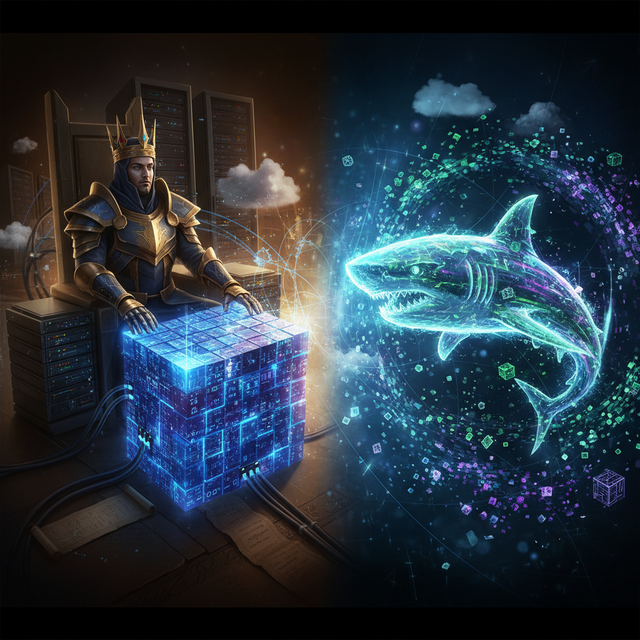
In the realm of data engineering, the quest for efficient and insightful data processing is perpetual. Businesses today demand not only the ability to store vast quantities of information but also to derive value from it with increasing speed. This demand has led to the evolution of two dominant, yet fundamentally different, architectural philosophies: batch processing and real-time stream processing. We metaphorically refer to these as 'Kings' and 'Sharks' respectively – one representing established power and robustness, the other embodying agility, speed, and immediate impact.
The Reign of Kings: Batch Processing Architectures
Batch processing, the 'Kings' of data processing, represents the traditional paradigm where data is collected and processed in large blocks or 'batches' at scheduled intervals. This approach has been the backbone of enterprise data warehousing and business intelligence for decades, proving its reliability and efficiency for specific use cases.
Characteristics of Batch Processing
Batch systems excel at handling large volumes of data that can tolerate latency. Data is typically accumulated over hours or days before being fed into a processing engine. The processing itself is often resource-intensive, requiring significant computational power for a finite period. Key characteristics include:
- High Latency: Data insights are available minutes, hours, or even days after the data is generated.
- High Throughput: Capable of processing massive datasets efficiently once initiated.
- Cost-Effectiveness: Resources can be provisioned and de-provisioned, or scaled, for specific processing windows, potentially reducing always-on infrastructure costs.
- Simplicity in Design (relative to real-time): Error handling and reprocessing are often simpler, as the entire batch can be re-run.
Typical Use Cases
Batch processing remains indispensable for scenarios like:
- End-of-day Reporting: Generating daily, weekly, or monthly reports on sales, inventory, or user activity.
- ETL (Extract, Transform, Load) Pipelines: Moving and transforming data from operational databases into data warehouses for analytical purposes.
- Historical Analysis: Building comprehensive datasets for long-term trend analysis, machine learning model training, and regulatory compliance.
- Billing Systems: Processing accumulated transactions for periodic invoicing.
Technologies commonly associated with batch processing include traditional relational databases, Apache Hadoop (with MapReduce), Apache Spark (which also supports streaming but excels at batch), and various cloud data warehousing solutions like Snowflake or Google BigQuery.
The Rise of the Sharks: Real-time Stream Processing Architectures
In contrast, real-time stream processing, the 'Sharks' of our analogy, deals with data as it is generated, processing individual events or small windows of events continuously. The emphasis is on immediacy, providing insights and enabling actions within milliseconds or seconds of data creation.
Characteristics of Stream Processing
Stream processing architectures are designed for speed and responsiveness. They operate on unbounded data streams, meaning there's no defined 'end' to the data, and processing is continuous. Key characteristics include:
- Low Latency: Insights and actions are delivered almost instantaneously.
- Event-Driven: Reacts to individual data points or small sequences of events as they occur.
- High Availability: Often designed for continuous operation with robust fault tolerance.
- Complexity: Building and maintaining stateful stream processing applications can be more complex due to challenges in managing state, event ordering, and exactly-once processing guarantees.
Typical Use Cases
Stream processing is crucial for applications where immediate action or near-instantaneous insights are critical:
- Fraud Detection: Identifying suspicious transactions as they happen.
- Personalized User Experiences: Real-time recommendations, dynamic content delivery, and adaptive user interfaces.
- IoT Data Ingestion and Analysis: Monitoring sensor data from connected devices for anomalies or operational insights.
- Network Monitoring and Security: Detecting intrusions or performance issues in real-time.
- Financial Trading: Executing trades based on rapidly changing market conditions.
Leading technologies in this space include Apache Kafka (for distributed streaming platforms), Apache Flink, Apache Storm, and various cloud-native streaming services like Amazon Kinesis or Google Cloud Dataflow.
Key Differences and Trade-offs
Choosing between these two paradigms involves understanding their core differences and the inherent trade-offs:
| Feature | Batch Processing ('Kings') | Stream Processing ('Sharks') | | :---------------- | :------------------------------------------------------- | :--------------------------------------------------------- | | Latency | High (hours, days) | Low (milliseconds, seconds) | | Data Volume | Processes large, bounded datasets | Processes continuous, unbounded streams | | Data Freshness| Stale data, periodic updates | Real-time, up-to-the-minute data | | Complexity | Generally simpler for data consistency and error handling| Higher for state management, ordering, and fault tolerance | | Cost Model | Often burstable, optimized for specific windows | Continuous operation, potentially higher always-on costs | | Data Model | Typically structured, schema-on-write | Can be semi-structured, schema-on-read often preferred |
Engineers must weigh these factors against business requirements. A system demanding immediate alerts for critical events would lean heavily towards stream processing, while a system for monthly financial reporting might be perfectly served by batch processing.
The Hybrid Approach: A Unified Kingdom
In many modern architectures, the distinction between batch and stream processing blurs, giving rise to hybrid solutions. The 'Lambda Architecture' and 'Kappa Architecture' are prime examples. The Lambda Architecture combines both a batch layer for comprehensive, accurate historical views and a speed layer for real-time, albeit potentially approximate, insights. The Kappa Architecture, a simplification, aims to use a single stream processing engine for both real-time and historical data by replaying streams as needed.
This convergence acknowledges that most complex applications require both immediate responsiveness and robust, historical analytical capabilities. Technologies like Apache Spark, with its ability to handle both batch and micro-batch (near real-time) processing, and Apache Flink, designed for true continuous streaming but also capable of batch, exemplify this trend towards unified processing frameworks.
Choosing Your Champion: Decision Factors
When designing your data architecture, consider the following:
- Business Requirements: What is the acceptable latency for insights? Does the business need immediate action or periodic summaries?
- Data Volume and Velocity: How much data is generated, and how quickly? High velocity often points to streaming.
- Data Consistency and Accuracy: What level of data consistency (e.g., exactly-once processing) is required? This can be more challenging to guarantee in real-time systems.
- Cost and Resources: What are the budget constraints for infrastructure and operational overhead?
- Team Expertise: Does your engineering team have the skills to build and maintain complex distributed streaming systems?
Conclusion
The 'Sharks' and 'Kings' of data processing—real-time stream processing and batch processing—each offer distinct advantages. Batch processing provides robust, cost-effective solutions for large-scale historical analysis, while stream processing delivers the immediacy required for real-time decision-making and dynamic applications. Modern data architectures increasingly leverage hybrid approaches, combining the strengths of both to create comprehensive, responsive, and resilient systems. The key for engineers lies in understanding the nuances of each paradigm and strategically applying them to meet specific business and technical demands, ensuring data not only flows but truly empowers the organization.