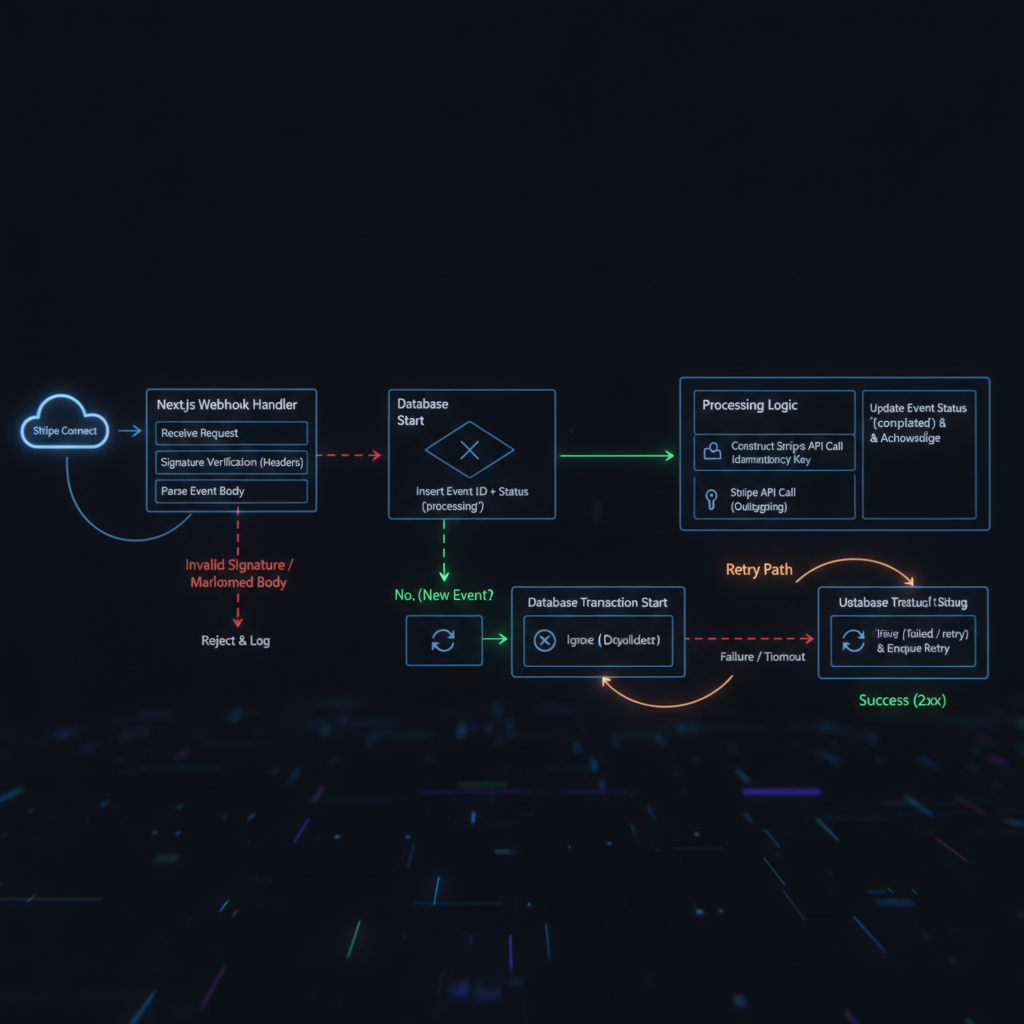
Building a robust Stripe Connect marketplace means dealing with a constant stream of events. For technical founders and CTOs, the challenge isn't just receiving webhooks, but processing them reliably without introducing data inconsistencies or duplicate operations. If you've ever wrestled with an invoice.paid event triggering multiple payouts, or a payment_intent.succeeded causing a double charge, you're facing the core problem of Stripe Connect webhook idempotency and event duplication.
This isn't a beginner's guide to setting up webhooks. This is for the senior engineer who has already tried the basic approaches and hit the production edge cases: network failures, Stripe's own retry policies, and the subtle race conditions that can corrupt your marketplace's financial state. We'll dive into architecting a webhook handler that withstands these challenges, ensuring every financial transaction is processed exactly once.
TL;DR
- Stripe webhooks can and will arrive multiple times; your system must be designed for graceful handling.
- Leverage Stripe's
idempotency_keyfor outgoing API calls from your webhook handler to prevent duplicate operations. - Implement robust internal event tracking (e.g.,
event.idin your database) to prevent reprocessing already handled webhooks. - Prioritize transactional integrity for all state changes triggered by webhooks, ideally within a single database transaction.
- Design for eventual consistency and incorporate robust retry mechanisms for transient failures, coupled with comprehensive monitoring.
The Inevitable Reality: Webhook Duplication
Stripe's webhook system is designed for reliability, not perfect delivery. This means that while Stripe attempts to deliver each event exactly once, network issues, server timeouts, and Stripe's own retry policies mean your endpoint might receive the same event multiple times. This isn't a bug; it's a fundamental aspect of distributed systems. For a Stripe Connect marketplace, where a single event might trigger a payout, update an account balance, or mark an order as fulfilled, duplicate processing can have severe financial implications.
Consider an account.payout.succeeded event. If your system processes this twice, you might incorrectly credit a seller's internal balance twice, leading to an overpayment. Similarly, a payment_intent.succeeded event, if processed non-idempotently, could lead to duplicate order creation or even double charging a customer if your payment flow isn't tightly controlled. The goal is to build a system that, regardless of how many times a webhook arrives, performs the intended action only once.
Beyond event.id: True Idempotency for Webhooks
Many engineers initially think that simply storing event.id from the Stripe event object in their database and checking for its existence is sufficient. While this is a crucial first step, it only guarantees that that specific Stripe event object is processed once. It doesn't guarantee that the downstream operations (e.g., creating a payout, updating a user's subscription) triggered by that event are also idempotent.
For example, if your webhook handler successfully logs event.id but then fails to create a payout due to a network error, and Stripe retries the webhook, your system will see the event.id as already processed and might skip the payout creation entirely. Or, worse, if the payout creation succeeds but the database transaction to mark the event as processed fails, the next retry could attempt the payout again. True idempotency requires a more comprehensive strategy.
Stripe's idempotency_key: Your First Line of Defense
Stripe provides a powerful mechanism for ensuring idempotency for API requests you make to Stripe: the idempotency_key parameter. When you make a request to Stripe with an idempotency_key, Stripe ensures that if the same request (with the same key) is received within a 24-hour window, it will only be processed once. Subsequent requests with the same key will return the result of the original successful request, without re-executing the operation.
This is invaluable. Whenever your webhook handler needs to make an API call to Stripe (e.g., creating a transfer, issuing a refund, updating a subscription), you must include an idempotency_key. A common pattern is to derive this key from the Stripe webhook event.id itself, or a combination of the event.id and the specific action being performed. For instance, event.id + '-create-payout' or event.id + '-update-subscription'. This ensures that even if your server crashes right after making the Stripe API call but before updating your database, a retried webhook won't cause a duplicate Stripe operation.
// Example: Using idempotency_key when creating a transfer in a Next.js API route
// pages/api/stripe-webhook.ts or app/api/stripe-webhook/route.ts

import { NextRequest, NextResponse } from 'next/server';
import Stripe from 'stripe';
import { buffer } from 'micro'; // For Next.js Pages Router or manual body parsing
import { db } from '@/lib/db'; // Your database client

const stripe = new Stripe(process.env.STRIPE_SECRET_KEY!, {
  apiVersion: '2024-04-10',
});

// Important: Disable Next.js body parser for webhooks
export const config = {
  api: {
    bodyParser: false,
  },
};

export async function POST(req: NextRequest) {
  const signature = req.headers.get('stripe-signature');
  const webhookSecret = process.env.STRIPE_WEBHOOK_SECRET;

  if (!signature || !webhookSecret) {
    return NextResponse.json({ error: 'Missing Stripe signature or secret' }, { status: 400 });
  }

  let event: Stripe.Event;
  try {
    const buf = await req.text(); // For App Router, req.text() is sufficient
    // For Pages Router, use `buffer(req)`
    event = stripe.webhooks.constructEvent(buf, signature, webhookSecret);
  } catch (err: any) {
    console.error(`Webhook signature verification failed: ${err.message}`);
    return NextResponse.json({ error: `Webhook Error: ${err.message}` }, { status: 400 });
  }

  // Check if we've already processed this exact Stripe event ID
  const existingEvent = await db.stripeEvent.findUnique({
    where: { id: event.id },
  });

  if (existingEvent) {
    console.log(`Stripe event ${event.id} already processed. Status: ${existingEvent.status}`);
    // Depending on your status tracking, you might want to re-check the outcome
    // or simply return 200 OK if it was already successful.
    if (existingEvent.status === 'completed') {
      return NextResponse.json({ received: true, message: 'Event already completed' });
    } else if (existingEvent.status === 'processing') {
      // This indicates a potential race condition or a long-running task.
      // For simplicity, we'll assume a quick idempotent operation and return OK.
      // In a real system, you might want to log this or trigger a re-evaluation.
      return NextResponse.json({ received: true, message: 'Event currently processing' });
    }
  }

  // Record the event as processing to prevent race conditions
  await db.stripeEvent.create({
    data: {
      id: event.id,
      type: event.type,
      data: event.data as any, // Store full event data for debugging
      status: 'processing',
      receivedAt: new Date(),
    },
  });

  try {
    switch (event.type) {
      case 'payment_intent.succeeded': {
        const paymentIntent = event.data.object as Stripe.PaymentIntent;
        console.log(`PaymentIntent ${paymentIntent.id} succeeded.`);

        // Example: Fulfill order, trigger marketplace logic
        // Ensure your internal order fulfillment is also idempotent

        // If this event triggers a Stripe API call (e.g., creating a transfer to a connected account)
        // ALWAYS use an idempotency_key.
        const transferIdempotencyKey = `${event.id}-create-transfer-${paymentIntent.id}`;
        // Assume we have a function to calculate amount and destination account
        // const amountToTransfer = calculateTransferAmount(paymentIntent);
        // const destinationAccountId = getDestinationAccount(paymentIntent);

        // Example: Create a transfer (simplified)
        // await stripe.transfers.create({
        //   amount: 1000, // example amount
        //   currency: 'usd',
        //   destination: 'acct_1234567890abcdefg',
        //   metadata: { paymentIntentId: paymentIntent.id },
        // }, { idempotencyKey: transferIdempotencyKey });

        break;
      }
      case 'customer.subscription.updated': {
        const subscription = event.data.object as Stripe.Subscription;
        console.log(`Subscription ${subscription.id} updated.`);

        // Example: Sync subscription status with your internal user data
        // This operation should also be idempotent based on subscription.id and status
        break;
      }
      case 'account.payout.succeeded': {
        const payout = event.data.object as Stripe.Payout;
        console.log(`Payout ${payout.id} succeeded.`);

        // Example: Update internal seller balance, mark payout as complete
        // This internal update must be idempotent. E.g., only update if the payout isn't already marked succeeded.
        break;
      }
      // ... handle other event types
      default:
        console.warn(`Unhandled event type: ${event.type}`);
    }

    // Mark the Stripe event as completed
    await db.stripeEvent.update({
      where: { id: event.id },
      data: { status: 'completed' },
    });

    return NextResponse.json({ received: true });
  } catch (error: any) {
    console.error(`Error processing webhook ${event.id} of type ${event.type}:`, error);

    // Mark the Stripe event as failed
    await db.stripeEvent.update({
      where: { id: event.id },
      data: { status: 'failed', errorMessage: error.message },
    });

    // Crucial: Return a non-2xx status code to signal Stripe to retry
    return NextResponse.json({ error: 'Webhook processing failed' }, { status: 500 });
  }
}
This snippet demonstrates several key principles:
- Signature Verification: Essential for security, ensuring the webhook truly came from Stripe.
event.idTracking: We store theevent.idin astripeEventtable (or similar) with a status. A unique constraint onidprevents duplicate insertions.- Status Management:
processing,completed,failedallows tracking the lifecycle and handling retries. - Idempotency Key Usage: Although commented out for brevity, any
stripe.transfers.createor similar call must include anidempotencyKeyderived from theevent.id. - Error Handling: Returning a 500 status code tells Stripe to retry the webhook, which is critical for transient failures.
Architecting a Robust Webhook Handler
Beyond the code snippet, a robust webhook handler for a marketplace requires careful architectural considerations:
1. Signature Verification: The Non-Negotiable Security Step
Always, always verify the webhook signature. This prevents malicious actors from sending fake webhook events to your endpoint, which could lead to fraudulent transactions or data manipulation. Stripe sends a Stripe-Signature header with each event, which you must use with stripe.webhooks.constructEvent to verify the payload. Failing to do so is a critical security vulnerability.
2. Transactional Processing and Status Tracking
Any operation that modifies your database state (e.g., updating an order, crediting a seller, changing subscription status) should ideally be wrapped in a database transaction. This ensures atomicity: either all changes succeed, or none do. If your internal logic fails mid-way, the transaction can be rolled back, leaving your database in a consistent state. Coupled with this, maintain a stripe_events table (as shown in the code) with a status column (pending, processing, completed, failed) and a unique constraint on the event.id. This allows you to quickly check if an event has already been processed or is currently being processed.
3. Unique Constraints for Internal Operations
While event.id tracks the Stripe event, your internal operations might need their own idempotency. For instance, if payment_intent.succeeded triggers an order creation, ensure your orders table has a unique constraint on a field like stripePaymentIntentId. This prevents creating duplicate orders even if your webhook handler logic somehow bypasses the event.id check and attempts to create an order twice for the same payment intent.
Handling Retries and Failures Gracefully
Stripe will retry webhooks that don't return a 2xx status code. It uses an exponential backoff strategy, retrying for up to three days. This is your safety net for transient issues (e.g., your server was temporarily down, a database connection timed out). Your webhook handler must return a non-2xx status code (e.g., 500 Internal Server Error) if processing fails.
For persistent failures, or operations that require longer processing, consider offloading the heavy lifting to a queue (e.g., a message queue like RabbitMQ, SQS, or a simple job queue). Your webhook handler's job then becomes to quickly verify the signature, log the event, and enqueue it for asynchronous processing. The job processor would then handle the actual business logic, with its own retry mechanisms (e.g., exponential backoff, dead-letter queues for unrecoverable failures). This pattern ensures your webhook endpoint remains responsive, preventing Stripe from giving up on retries prematurely.
Race Conditions and Concurrency
What happens if two identical webhooks (or two related webhooks) arrive at almost the same time? Without careful design, this can lead to race conditions. For example, two invoice.paid events might try to update the same seller's balance simultaneously.
- Database Transactions with Locks: For critical sections, use database-level locking mechanisms (e.g.,
SELECT ... FOR UPDATEin PostgreSQL) to ensure only one process can modify a specific record at a time. - Optimistic Concurrency: For less critical operations, use version numbers or
updated_attimestamps. When updating a record, check if the version or timestamp in the database matches the one you read. If not, another process modified it, and you can retry or handle the conflict. - Unique Constraints: As mentioned, apply unique constraints on relevant fields to prevent duplicate records (e.g.,
stripe_event_idon yourstripe_eventstable,payment_intent_idonorders). - Eventual Consistency: Accept that some data might not be instantly consistent across all systems. Design your marketplace to tolerate brief periods of inconsistency, with mechanisms to reconcile data over time.
Key Takeaways
- Assume Duplication: Always design your Stripe Connect webhook handlers with the expectation that events will be delivered multiple times.
- Dual Idempotency: Implement both Stripe's
idempotency_keyfor outgoing API calls and internalevent.idtracking for incoming webhooks. - Transactional Integrity: Wrap all critical database updates in transactions to maintain data consistency.
- Robust Error Handling: Return non-2xx status codes for failures to leverage Stripe's retry mechanism, and implement your own retry logic for asynchronous jobs.
- Security First: Never skip webhook signature verification.
- Monitor and Alert: Set up logging and alerting for webhook processing failures to quickly identify and resolve issues.
Ship this without the trial-and-error
Navigating the intricacies of Stripe Connect marketplaces, especially when dealing with production-grade webhook idempotency and complex billing flows, can be a significant engineering challenge. If you're building a marketplace and want to ensure rock-solid payment infrastructure without months of trial-and-error, PolarSoftBD specializes in production payments and AI engineering.
We build and optimize Stripe Connect integrations for marketplaces and usage-based billing systems, allowing you to focus on your core product. Learn more about our expertise in Stripe Integration.
Ready to accelerate your development and avoid common pitfalls? Schedule a free strategy call with PolarSoftBD to discuss your project. We've helped numerous technical founders and CTOs architect and deploy resilient payment systems, drawing on insights from complex projects like those covered in our guide to Stripe Connect Marketplace in Next.js and Stripe Connect Express vs Custom Accounts.