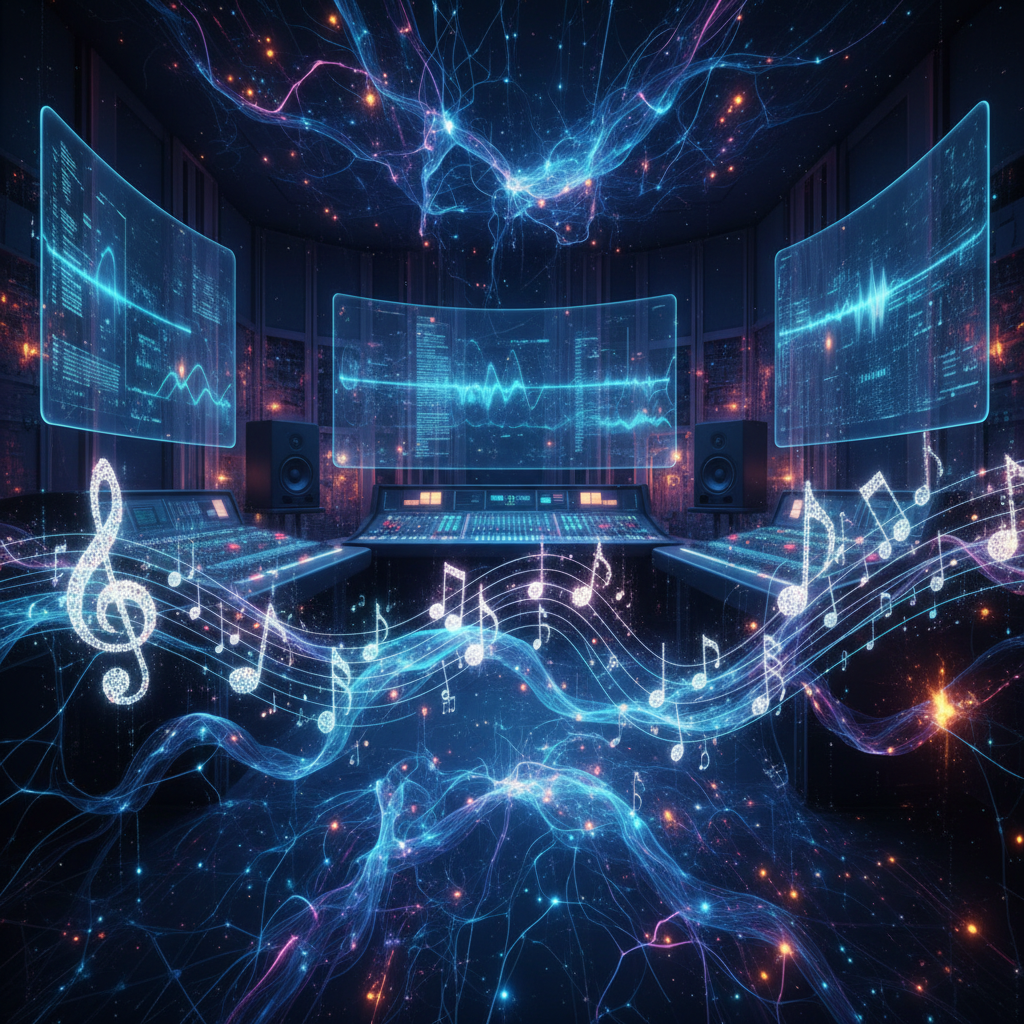
TL;DR: Artificial Intelligence is fundamentally transforming music production, offering engineers and artists powerful new tools for composition, mixing, and mastering. This article delves into the technical underpinnings and implications of AI's growing role in shaping the soundscapes of tomorrow.
Introduction: The Ever-Evolving Sound of Innovation
Music, at its core, is an art form deeply intertwined with technology. From the earliest drums to the intricate mechanics of a grand piano, from the revolutionary synthesizers of the 20th century to today's sophisticated Digital Audio Workstations (DAWs), new tools have consistently redefined the boundaries of creative expression. Today, we stand at the precipice of another seismic shift: the integration of Artificial Intelligence into every facet of music production. This isn't merely about automation; it's about augmentation, about unlocking new creative potentials that were once unimaginable. For engineering teams, this presents both fascinating challenges and immense opportunities to build the intelligent systems that will power the next generation of sonic artistry.
The Dawn of Algorithmic Creativity
The idea of algorithmic composition isn't new; pioneers like Iannis Xenakis explored mathematical approaches to music decades ago. However, modern AI, powered by machine learning and vast datasets, has propelled this concept into an entirely new dimension. Generative AI models, often built using neural networks such as Recurrent Neural Networks (RNNs) or Transformers, are trained on extensive libraries of existing music. This training allows them to learn patterns, structures, and stylistic nuances, enabling them to generate novel melodies, harmonies, rhythms, and even entire instrumental pieces.
Projects like Google's Magenta and OpenAI's Jukebox exemplify this capability, producing music that ranges from abstract soundscapes to genre-specific compositions. For artists renowned for their intricate compositions and innovative soundscapes, such as a Kendrick Lamar, AI tools could serve as powerful assistants, capable of generating complex rhythmic patterns or exploring harmonic variations that might inspire new directions without compromising artistic vision. The engineering challenge here lies in developing models that are not only musically coherent but also controllable and expressive, allowing human creators to guide the AI's output effectively.
Precision Engineering: AI in Mixing and Mastering
Beyond composition, AI is making significant inroads into the highly specialized and traditionally human-intensive domains of mixing and mastering. These processes, which involve balancing frequencies, dynamics, and spatial characteristics, are crucial for transforming raw recordings into polished, professional-sounding tracks. Historically, they required years of ear training and technical expertise.
Today, AI-powered plugins and services are democratizing access to high-quality audio engineering. Tools like iZotope Ozone's Master Assistant or LANDR utilize machine learning algorithms to analyze audio signals, identify sonic characteristics, and suggest optimal settings for equalization (EQ), compression, limiting, and stereo imaging. These systems learn from vast datasets of professionally mixed and mastered tracks, enabling them to apply intelligent processing that aims to achieve industry-standard loudness, clarity, and balance.
The underlying technology involves sophisticated signal processing techniques combined with deep learning. AI models perform spectral analysis to understand the frequency content, dynamic range analysis to identify transient information, and spatial analysis to gauge stereo width. Based on these analyses, the AI can then make informed decisions about applying various audio effects. For audio engineers, these AI assistants can streamline workflows, provide objective starting points, and even help in identifying problematic frequencies or dynamics that might otherwise be missed. The engineering focus here is on creating robust, low-latency algorithms that can process audio in real-time while maintaining sonic integrity and transparency.
AI as a Collaborative Partner: Redefining the Creative Process
A common debate surrounding AI in creative fields is whether it will replace human artists. However, the prevailing view, particularly within the engineering community, is that AI functions best as a collaborative partner or an augmentation tool. Instead of automating creativity entirely, AI can liberate artists from tedious or repetitive tasks, allowing them to focus on higher-level creative decisions.
Imagine an AI that can instantly generate multiple variations of a drum pattern, suggest harmonic progressions based on a given melody, or even analyze lyrical themes for consistency and emotional impact. This frees the artist to experiment more rapidly, break through creative blocks, and explore avenues they might not have considered. This paradigm shift, where technology doesn't just enable but actively participates in the creative process, represents a quiet, algorithmic reformation in how music is made. It's about building intelligent interfaces that bridge human intuition with computational power, fostering a symbiotic relationship between artist and machine.
Challenges and Ethical Frontiers
While the potential of AI in music production is immense, it also presents significant technical and ethical challenges. On the technical front, developing AI models that truly understand musical context, emotion, and cultural nuances remains a complex task. Ensuring explainability – understanding why an AI made a particular creative choice – is also crucial for artists who need to maintain control over their work.
Ethically, questions surrounding originality and copyright are paramount. If an AI is trained on copyrighted music, who owns the output? How do we prevent the creation of musical deepfakes or ensure fair compensation for artists whose work contributes to training data? Bias is another concern; if AI models are trained on datasets lacking diversity, they may perpetuate existing musical biases, leading to homogeneous or culturally insensitive outputs. Engineers must prioritize ethical data sourcing, transparent model development, and robust intellectual property frameworks to navigate these uncharted waters.
The Future Soundscape
The trajectory of AI in music production points towards an increasingly integrated and intelligent ecosystem. We can anticipate more sophisticated AI tools embedded directly into DAWs, offering real-time creative suggestions and automated mixing/mastering solutions. Personalized music generation, adaptive soundtracks for interactive media, and new forms of sonic interaction are all within reach.
Ultimately, while AI will undoubtedly transform the tools and techniques of music creation, the human element – the intention, the emotion, the story – will remain at the heart of compelling music. For engineers, the challenge and privilege lie in building the intelligent infrastructure that empowers artists to explore unprecedented creative territories, ensuring that the algorithm remains a muse, not a master.
Conclusion
Artificial Intelligence is not merely a technological novelty; it represents a fundamental shift in how music can be conceived, produced, and consumed. From algorithmic composition to intelligent audio engineering, AI is redefining the creative landscape. For the engineering teams at PolarSoftBD and beyond, the opportunity to shape these intelligent systems and contribute to this ongoing algorithmic revolution in music is both exciting and profound. The future of sound is being engineered, one algorithm at a time.