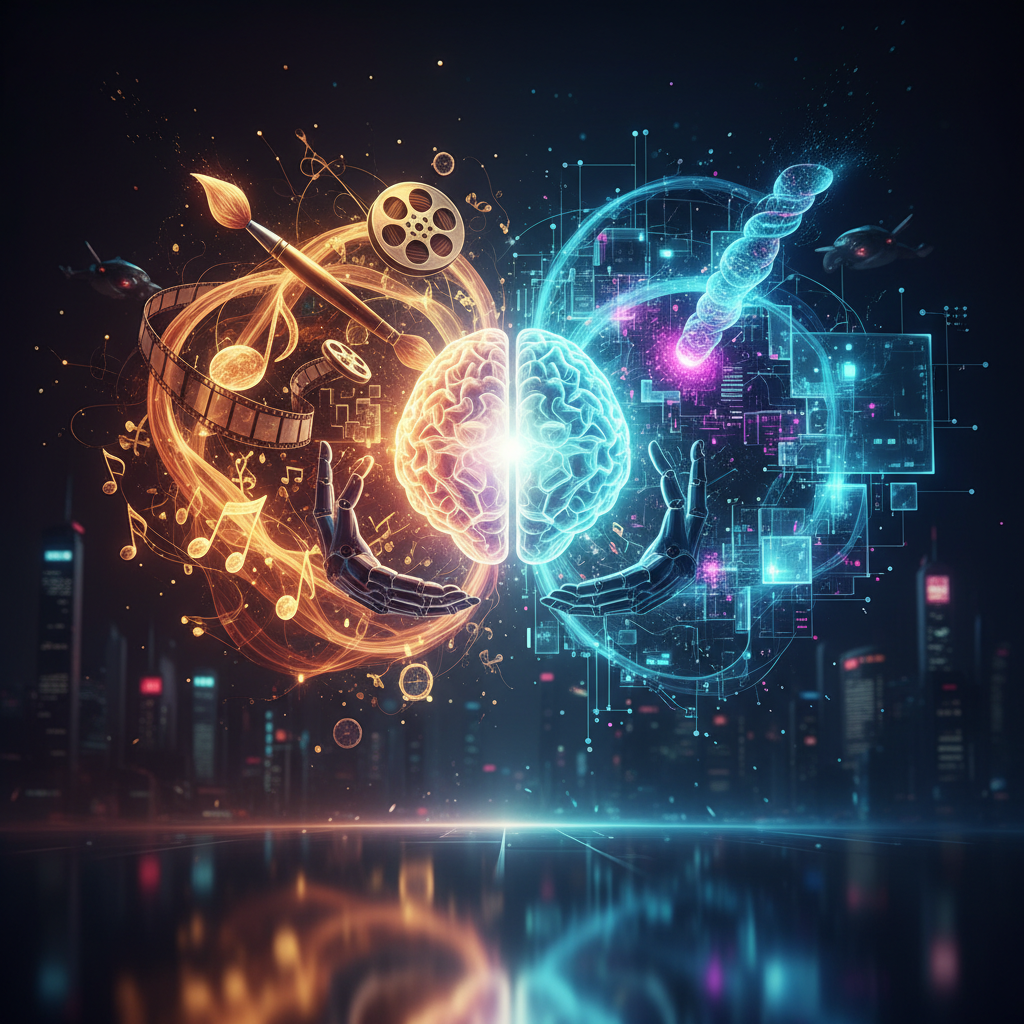
TL;DR Artificial Intelligence is no longer just a tool for data analysis; it's becoming a powerful collaborator in creative fields. From composing music and generating visual art to assisting in scriptwriting and film production, AI is reshaping how content is conceived, created, and consumed. While offering unprecedented possibilities for innovation and efficiency, its integration also raises crucial questions about authorship, ethics, and the enduring value of human creativity. This article explores the technological underpinnings and implications of AI's burgeoning role in the arts.
The Dawn of the Algorithmic Muse
The intersection of art and technology has always been a fertile ground for innovation. From the invention of the camera to digital audio workstations, engineers and artists have continuously pushed boundaries, leveraging new tools to express complex ideas and create immersive experiences. Today, Artificial Intelligence stands at the forefront of this evolution, offering capabilities that once belonged solely to the realm of science fiction. AI is not merely automating tasks; it's actively participating in the creative process, acting as a co-creator, an assistant, and sometimes, even the primary generator of artistic output.
This shift is powered by advancements in machine learning, particularly deep learning models, which can learn patterns from vast datasets of existing art, music, text, and visual media. By understanding these patterns, AI can then generate new content that adheres to specific styles, moods, or themes, opening up new avenues for artists and producers across various disciplines.
AI in Music Production and Composition
The music industry has been an early adopter of AI, integrating it into various stages of production. Digital Audio Workstations (DAWs) now feature AI-powered plugins that can assist with mastering, mixing, and even suggest melodic or harmonic structures. Generative AI models can compose original pieces of music in a specific genre, style, or mood, learning from extensive libraries of human-composed tracks.
Tools like Google's Magenta project or Amper Music allow users to generate custom soundtracks for videos, podcasts, or games with minimal input, often just a few parameters like tempo, instrumentation, and emotional tone. AI can also analyze vocal performances, correct pitch, and even synthesize realistic-sounding vocals, blurring the lines between human and machine performance. For engineers, this means developing more sophisticated algorithms for audio processing, real-time generation, and intuitive user interfaces that bridge the gap between creative intent and algorithmic execution.
Visual Arts and Filmmaking: Beyond the Green Screen
In visual arts and filmmaking, AI's impact is equally profound. Generative Adversarial Networks (GANs) and other deep learning models can create stunningly realistic images, illustrations, and even short video clips from text prompts. This capability is transforming concept art, character design, and even the creation of digital assets for virtual environments.
For filmmakers, AI assists in pre-production by analyzing scripts for pacing, character arcs, and potential audience reception. During production, AI-powered tools enhance visual effects (VFX), automate rotoscoping, and even generate realistic digital doubles or environments. Deepfake technology, while raising ethical concerns, showcases AI's ability to manipulate and synthesize video content with astonishing fidelity. The engineering challenges here involve optimizing rendering pipelines, developing robust content authentication methods, and creating intuitive AI-driven editing suites that empower rather than overwhelm human editors.
AI in Narrative and Storytelling
Storytelling is a uniquely human endeavor, yet AI is increasingly contributing to its evolution. Natural Language Processing (NLP) models are being trained on vast corpora of literature, screenplays, and journalistic articles, enabling them to generate coherent and contextually relevant text. AI can assist writers by suggesting plot twists, developing character backstories, or even drafting entire paragraphs in a specific author's style.
Interactive narratives and games are also benefiting from AI, which can create dynamic dialogue, adapt storylines based on player choices, and generate unique quests or scenarios. This offers unprecedented personalization and replayability. The engineering focus here is on developing AI models that understand complex narrative structures, maintain consistent character voices, and generate text that evokes genuine emotion and engagement from human audiences.
Challenges and Ethical Considerations
While the potential of AI in creative production is immense, it comes with significant challenges and ethical dilemmas. Authorship and intellectual property are complex issues when a machine contributes significantly to a work. Who owns the copyright to an AI-generated song or image? Bias in training data can lead to AI generating content that perpetuates stereotypes or lacks diversity, requiring careful curation and algorithmic fairness considerations.
Furthermore, the concern about job displacement for human artists and creators is legitimate. While AI is often framed as an assistive tool, its increasing autonomy could disrupt traditional creative roles. Engineers and developers must prioritize the development of AI systems that augment human creativity rather than replace it, ensuring that artists retain agency and control over their work.
The Enduring Human Element
Despite the remarkable capabilities of AI, the human element remains irreplaceable. AI excels at pattern recognition, synthesis, and efficient generation, but it lacks genuine consciousness, lived experience, and the unique emotional depth that drives human creativity. AI can mimic style, but it cannot authentically convey the human condition, nor can it truly innovate in the way a human artist, driven by personal vision and societal commentary, can.
Therefore, the most exciting future for AI in creative production lies in collaboration. AI can handle repetitive tasks, generate variations, and provide creative prompts, freeing human artists to focus on conceptualization, emotional resonance, and pushing artistic boundaries. It becomes a sophisticated instrument, an advanced brush, or a powerful synthesizer, but the artist wielding it remains the conductor of the creative symphony.
The Future: Hybrid Creativity and New Art Forms
The trajectory of AI in creative fields points towards a future of hybrid creativity. We can anticipate the emergence of new art forms that are impossible without the synergistic collaboration between human and machine intelligence. Imagine interactive films where the narrative adapts in real-time based on audience biometric feedback, or musical compositions that evolve infinitely, tailored to an individual's mood.
For engineering teams at PolarSoftBD and beyond, this means continued research into more nuanced AI models that understand context, emotion, and aesthetic principles. It involves developing robust, ethical frameworks for AI deployment in creative industries and building user-friendly tools that empower a new generation of artists. The algorithmic muse is here, and its collaboration with human ingenuity promises an exciting, unpredictable, and profoundly creative future.