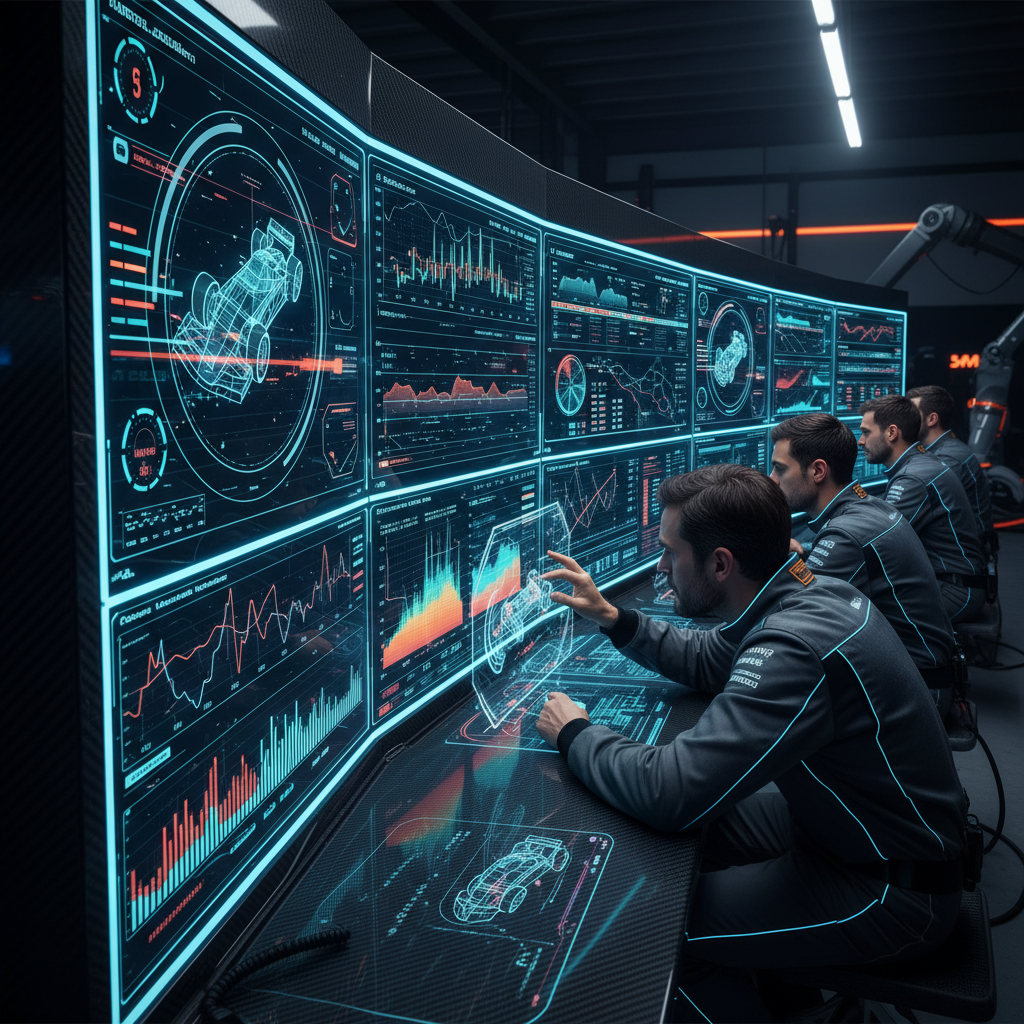
TL;DR: Formula 1 is a crucible of high-performance engineering, where victory increasingly hinges on the sophisticated capture, analysis, and application of vast data streams. Teams deploy thousands of sensors, advanced simulation models, and custom software platforms to make real-time strategic decisions, optimize car performance, and iterate design rapidly. This article delves into the digital infrastructure that underpins modern F1, from telemetry to predictive analytics, highlighting how software and data engineering are as crucial as driver skill and aerodynamic design.
The Digital Race: Engineering Excellence Through Data in Formula 1
Formula 1 is often seen as the pinnacle of motorsport, a thrilling spectacle of speed, precision, and human skill. Beneath the roar of the engines and the blur of carbon fiber, however, lies an equally intense battleground: the digital realm. Modern F1 is as much a data engineering challenge as it is a mechanical one. Every millisecond, every corner, every adjustment is meticulously measured, analyzed, and fed back into a complex system designed to extract every ounce of performance. For PolarSoftBD, understanding this fusion of physical engineering and advanced software is key to appreciating the cutting edge of data-driven performance optimization.
The Torrent of Telemetry: Data Acquisition at Hyperspeed
Imagine a single Formula 1 car generating hundreds of gigabytes of data over a race weekend. This isn't an exaggeration. Each car is a mobile data center, equipped with hundreds of sensors monitoring everything from tire temperature and pressure, brake wear, suspension travel, engine RPM, fuel flow, aerodynamic loads, and even the driver's heart rate and G-forces experienced. This data, often referred to as telemetry, is streamed in real-time from the car to the pit wall and back to the factory.
The sheer volume and velocity of this data present significant engineering challenges. Low-latency, high-bandwidth communication systems are critical to ensure that strategists and engineers have up-to-the-second information. Data is often transmitted via secure radio links, sometimes augmented by satellite communication for remote tracks. The data isn't just raw numbers; it's often pre-processed at the edge (on the car) to reduce bandwidth requirements and highlight critical anomalies before being sent to the central systems for deeper analysis.
Simulation and Digital Twins: Racing Before the Race
Before a car even touches the track, countless hours are spent in the digital domain. F1 teams are pioneers in computational fluid dynamics (CFD) and finite element analysis (FEA), simulating every aerodynamic surface and structural component down to the smallest detail. These simulations run on massive computing clusters, often leveraging cloud infrastructure, to model airflow, stress distribution, and thermal dynamics with incredible precision.
Beyond component-level simulation, teams employ sophisticated full-car models, often referred to as "digital twins." These digital representations of the physical car are constantly updated with real-world data, allowing engineers to predict how changes to setup, fuel loads, or tire compounds will affect performance. Driver-in-the-loop (DIL) simulators take this a step further, integrating a real driver into a virtual environment that accurately mimics the car's behavior and track conditions. This allows drivers to practice and engineers to test setups in a risk-free, highly controlled environment, generating even more data points for analysis. The fidelity of these simulations is paramount, requiring robust physics engines and rendering pipelines that can keep pace with real-time human input.
Real-time Analytics and Strategic Decision-Making
The pit wall is the nerve center of race day operations, where engineers and strategists make critical decisions that can win or lose a race. This is where real-time data analytics truly shines. Custom-built software dashboards display key performance indicators (KPIs), trend analyses, and predictive models. These systems help strategists determine optimal pit stop windows, react to safety car deployments, manage tire degradation, and even anticipate competitor strategies.
Predictive algorithms, often incorporating statistical models and historical data, are used to forecast tire wear rates, fuel consumption, and lap times under various scenarios. For instance, a system might predict the probability of rain in the next 10 minutes, or how many laps a specific tire compound can realistically last before a significant performance drop. The challenge here is not just processing data quickly, but also presenting it in a clear, actionable format to human decision-makers under immense pressure. The latency from sensor to screen must be minimal, often measured in milliseconds, to ensure decisions are made with the most current information.
The Software Ecosystem: Custom Tools and Cloud Power
Behind the scenes, each F1 team operates a vast and complex software ecosystem. This isn't off-the-shelf software; much of it is custom-developed in-house, tailored to the specific needs and philosophies of the team. This includes:
- Telemetry Processing Engines: Ingesting, cleaning, and structuring raw sensor data.
- Data Warehouses/Lakes: Storing petabytes of historical race and simulation data.
- Visualization Tools: Creating intuitive dashboards and graphs for engineers.
- Simulation Platforms: Running CFD, FEA, and full-car models.
- Strategy Engines: Algorithms for race strategy optimization.
- Configuration Management: Tracking every component change on the car.
- Communication Systems: Secure internal and external communication.
Many teams leverage hybrid cloud architectures, using on-premises high-performance computing (HPC) for sensitive, latency-critical simulations and public cloud providers for scalable data storage, less time-critical simulations, and global collaboration. This allows them to burst computing power as needed, optimizing costs and resource allocation. The development lifecycle for these tools is incredibly agile, with new features and optimizations often deployed between races to address performance gaps or exploit new data insights.
Challenges and the Road Ahead
The challenges in F1 data engineering are constant: managing ever-increasing data volumes, ensuring data integrity and security, reducing latency, and building more accurate predictive models. The competitive nature of the sport drives continuous innovation in these areas.
Looking ahead, we can expect even greater integration of simulation and real-world data, leading to more sophisticated "living" digital twins that adapt and learn. The use of edge computing will likely expand, pushing more processing power closer to the data source (the car itself) to enable faster, more autonomous decision-making or pre-analysis. The pursuit of marginal gains will continue to drive advancements in data science, software architecture, and real-time systems, making F1 a fascinating case study for any engineering blog.
Conclusion
Formula 1 is a testament to what's possible when cutting-edge engineering meets relentless data analysis. It's a sport where the milliseconds gained from an aerodynamic tweak are as important as the milliseconds saved by a perfectly executed pit stop, and both are increasingly informed by sophisticated software and data systems. The digital race is just as intense as the one on the track, showcasing how robust data pipelines, advanced simulation, and real-time analytics are fundamental to achieving peak performance in the most demanding environments.