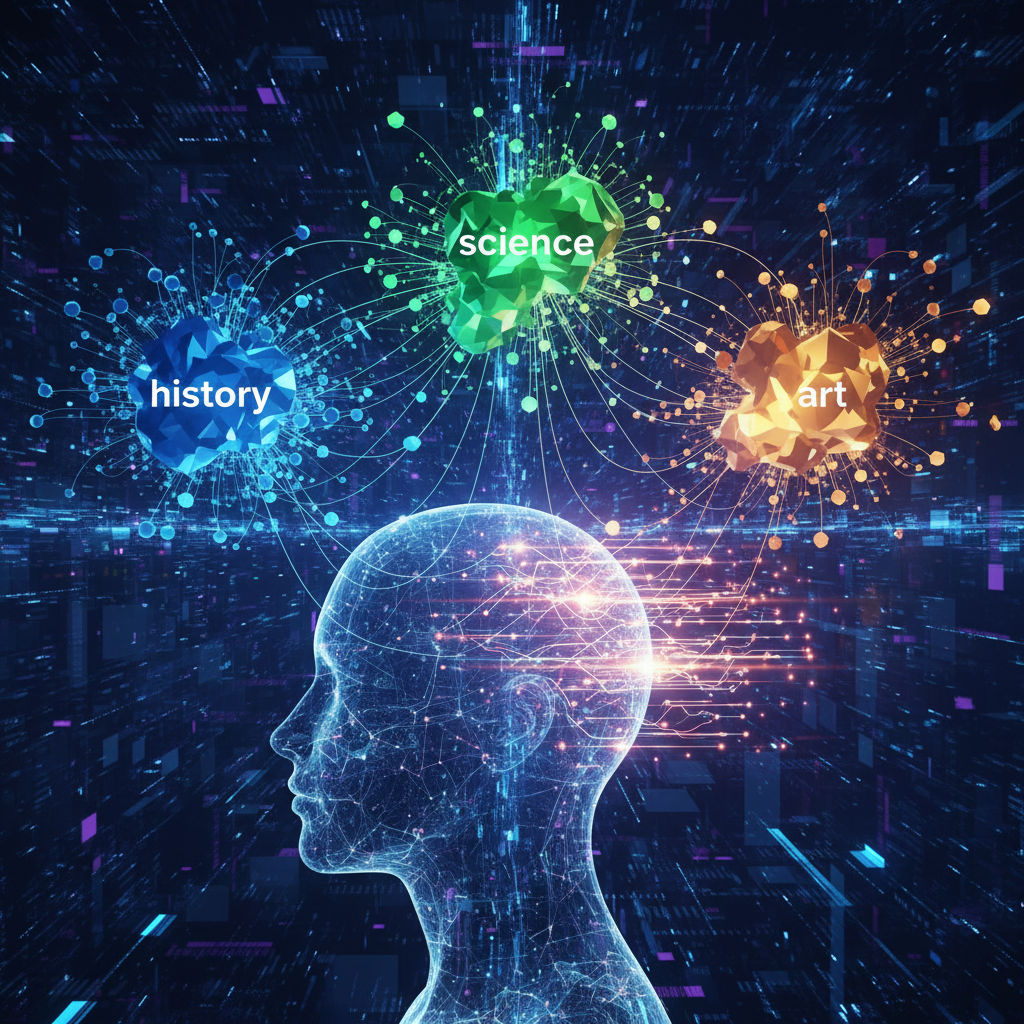
TL;DR Ken Jennings' unparalleled Jeopardy! performance highlighted the immense complexity of human general knowledge and rapid recall. This article delves into the engineering challenges of building computational systems that can approach such a feat, focusing on knowledge representation, natural language understanding, efficient retrieval, and real-time processing, offering insights into designing scalable and intelligent knowledge systems.
The Human Benchmark: Ken Jennings and the Challenge to Computation
For 74 consecutive games in 2004, Ken Jennings captivated audiences with his encyclopedic knowledge, lightning-fast recall, and strategic gameplay on Jeopardy!. His unprecedented winning streak wasn't just a pop culture phenomenon; it served as a powerful, albeit informal, benchmark for the capabilities of human general intelligence. For engineers and computer scientists, Jennings' performance posed a fascinating question: how do we build systems that can store, process, and retrieve knowledge with similar breadth, depth, and speed?
Jennings' success wasn't merely about memorization. It involved nuanced language comprehension, contextual understanding, inference, and the ability to quickly synthesize information under pressure. These are precisely the challenges that drive innovation in fields like natural language processing (NLP), knowledge representation, and system architecture. Emulating or even surpassing such human cognitive functions requires sophisticated engineering.
Architecting for Vast Knowledge: The Foundation
Building a system capable of accessing and processing a comprehensive knowledge base begins with its fundamental architecture. Unlike a human brain, which learns organically, a computational system requires explicit design for knowledge acquisition, storage, and retrieval.
Knowledge Representation: Beyond Simple Databases
Traditional relational databases struggle with the sheer diversity and interconnectedness of general knowledge. To effectively store facts, concepts, and relationships across myriad domains, engineers often turn to more flexible structures. Knowledge graphs, for instance, represent entities (people, places, events) as nodes and their relationships as edges. This semantic network approach allows for richer contextual queries and complex reasoning than flat data tables. The challenge lies in scaling these graphs to encompass billions of facts while maintaining semantic consistency and efficient traversals.
Natural Language Understanding: Deciphering the Clue
Jeopardy! clues are rarely straightforward. They often involve wordplay, idioms, historical references, and require a deep understanding of syntax and semantics. A system must not just match keywords but truly comprehend the meaning and intent behind a natural language query. This is where advanced NLP techniques come into play. Parsing complex sentence structures, resolving ambiguities, identifying named entities, and understanding coreferences are critical. The engineering task is to develop robust NLP pipelines that can process diverse linguistic inputs accurately and efficiently, often leveraging statistical models and deep learning architectures without explicitly naming them as such.
The Speed of Thought: Retrieval and Latency
Knowing the answer is only half the battle on Jeopardy!; buzzing in first is equally crucial. This translates directly to the need for ultra-low-latency retrieval and processing in knowledge systems.
Efficient Indexing and Search Algorithms
With petabytes of potential information, a system cannot sequentially scan its entire knowledge base for every query. Highly optimized indexing strategies are paramount. Techniques like inverted indexes, semantic indexes, and vector embeddings allow for rapid lookup and similarity searches. The engineering challenge is to design and maintain these indexes such that they are both comprehensive and incredibly fast, even with continuous updates to the knowledge base.
Real-time Contextual Processing
When a clue is presented, the system must not only retrieve potential answers but also evaluate their relevance within the specific context of the question. This often involves dynamic filtering, scoring, and ranking algorithms. For instance, if a clue asks for a