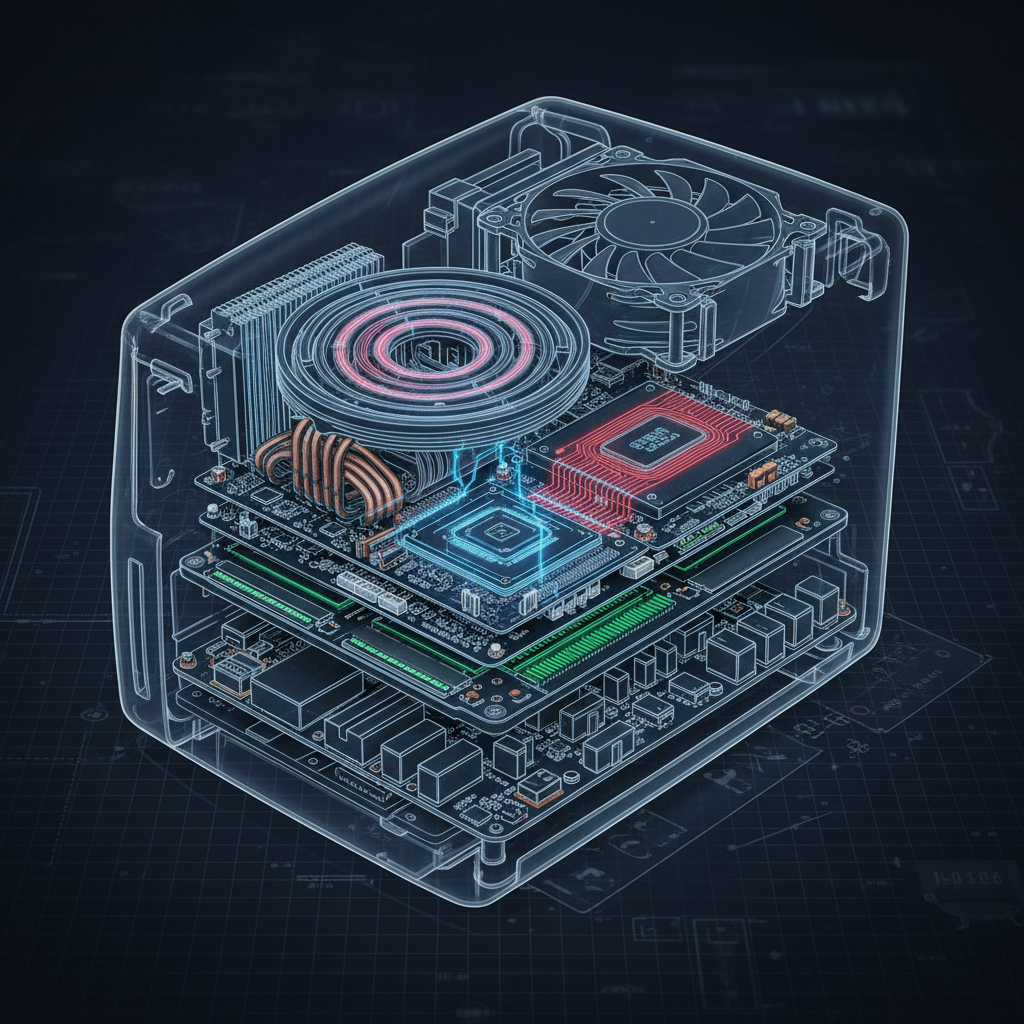
TL;DR: PlayStation consoles represent a fascinating journey in hardware engineering, continually pushing boundaries from custom MIPS CPUs in PS1 to the complex Cell processor in PS3, and finally embracing developer-friendly x86 architectures with PS4 and PS5. Each generation presented unique challenges in CPU/GPU design, memory management, and thermal solutions, culminating in the high-speed NVMe SSDs and ray tracing capabilities of the latest iteration, all while balancing performance, cost, and developer accessibility.
Introduction
For nearly three decades, PlayStation has been synonymous with groundbreaking interactive entertainment. Beyond the captivating games and immersive experiences lies a testament to relentless engineering innovation. From its humble beginnings as a CD-ROM add-on for another console, PlayStation evolved into a standalone powerhouse, with each iteration presenting a fresh set of architectural challenges and triumphs. This article delves into the core engineering decisions and hardware evolution that have defined PlayStation, exploring the intricate journey from simple 3D rendering to today's hyper-realistic virtual worlds.
The PS1 Era: Simplicity and Innovation
The original PlayStation, released in 1994, was a marvel of its time, primarily due to its focus on 3D graphics. Its core was a 32-bit MIPS R3000A-compatible CPU clocked at 33.86 MHz, paired with a custom Graphics Processing Unit (GPU) and a Geometry Transformation Engine (GTE). This combination allowed for hardware-accelerated polygon rendering, a significant leap from the sprite-based graphics prevalent in previous generations. Engineers faced the challenge of efficiently rendering complex 3D scenes with limited memory (2MB RAM, 1MB VRAM). The GPU handled texture mapping, Gouraud shading, and basic lighting, laying the foundation for modern 3D gaming. Its architecture, while seemingly simple by today's standards, was a bold step that democratized 3D gaming and cemented PlayStation's place in history.
PS2: The Emotion Engine and Vector Processing
The PlayStation 2, launched in 2000, introduced one of the most iconic and complex console processors ever devised: the Emotion Engine (EE). This custom 128-bit CPU, co-developed by Sony and Toshiba, operated at 299 MHz and featured a MIPS R5900 core alongside two Vector Units (VUs). These VUs were specialized floating-point processors designed for parallel computation, crucial for game physics, animation, and advanced graphics effects. The EE's unique architecture, coupled with a dedicated Graphics Synthesizer (GS) and 32MB of fast RDRAM, offered immense processing power. However, its unconventional design posed a steep learning curve for developers, who had to master parallel programming across the EE's various components to extract maximum performance. Despite the complexity, the PS2's raw power and innovative design allowed for unprecedented visual fidelity and gameplay depth, making it the best-selling home console of all time.
PS3: The Cell Broadband Engine - Ambition and Complexity
With the PlayStation 3 in 2006, Sony pushed the boundaries of processor design even further with the Cell Broadband Engine. A joint venture between Sony, Toshiba, and IBM, the Cell processor was a heterogeneous multi-core chip running at 3.2 GHz. It comprised a PowerPC-based Processor Element (PPE) and eight Synergistic Processor Elements (SPEs), seven of which were available to developers (one was reserved for the operating system). Each SPE was a powerful vector processor with its own local store, designed for highly parallel tasks. The Cell's architecture was revolutionary, offering supercomputer-level performance in specific scenarios, but its complexity was a double-edged sword. Programming for the Cell required meticulous task partitioning and data management across its disparate cores, a significant challenge that often led to developers struggling to fully utilize its potential. Despite its difficulties, the Cell enabled some truly impressive graphical feats and computational capabilities for its era.
PS4: Embracing x86 - Developer Friendliness and Performance
Learning from the PS3's development challenges, Sony made a pivotal architectural shift with the PlayStation 4 in 2013. The PS4 embraced a more conventional, PC-like x86-64 architecture, featuring a custom Accelerated Processing Unit (APU) developed by AMD. This APU integrated an 8-core "Jaguar" CPU and a Radeon-based GPU into a single chip. Crucially, it featured 8GB of unified GDDR5 memory, providing both the CPU and GPU with high-bandwidth access to a single pool of fast RAM. This move drastically simplified game development, allowing studios to port games more easily and focus on creative endeavors rather than wrestling with exotic hardware. While less "exotic" than its predecessors, the PS4's architecture was a pragmatic engineering choice that prioritized developer accessibility without compromising on raw graphical horsepower, leading to a robust library of high-quality titles.
PS5: RDNA 2 and NVMe - Next-Gen Performance and Speed
The latest iteration, the PlayStation 5, launched in 2020, builds upon the successful x86 foundation while introducing significant advancements. At its heart lies a custom AMD Zen 2 CPU (8 cores, 16 threads) and a custom RDNA 2 GPU, both capable of variable frequencies up to 3.5 GHz and 2.23 GHz respectively. This powerful combination enables features like hardware-accelerated ray tracing, delivering highly realistic lighting, reflections, and shadows. However, the most transformative engineering innovation of the PS5 is its ultra-high-speed custom NVMe SSD. With a raw throughput of 5.5 GB/s (and up to 9 GB/s compressed), this SSD fundamentally alters how games are designed, virtually eliminating loading screens and enabling seamless asset streaming. This shift from traditional hard drives to high-speed flash storage is not just about faster loading; it's about enabling new gameplay paradigms and larger, more detailed worlds that can stream data in real-time, drastically reducing bottlenecks previously imposed by I/O.
Engineering Challenges and Innovations Across Generations
Across all PlayStation generations, engineers have consistently tackled recurring challenges. Thermal management has always been critical, balancing powerful components with compact form factors. Power efficiency became increasingly important, especially with the PS3's Cell processor. Memory bandwidth and latency have been constant battlegrounds, from the PS1's limited VRAM to the PS4's unified GDDR5 and the PS5's custom I/O solution. The transition from entirely custom silicon to more standardized, yet highly optimized, architectures reflects an evolving understanding of the balance between raw power, development cost, and developer accessibility. Each console represents a complex interplay of CPU, GPU, memory, and I/O subsystems, meticulously designed to deliver cutting-edge gaming experiences within specific cost and power envelopes.
Conclusion
The engineering journey of PlayStation consoles is a compelling narrative of continuous innovation, bold architectural choices, and a pragmatic evolution towards developer-friendly platforms. From the pioneering 3D capabilities of the PS1 to the parallel processing might of the PS2's Emotion Engine and PS3's Cell, and finally to the streamlined power of the PS4's x86 APU and the PS5's revolutionary SSD, each console has pushed the boundaries of what's possible in interactive entertainment. These engineering feats are not just about faster processors or better graphics; they are about enabling new forms of artistic expression and delivering ever more immersive worlds to millions of players worldwide, a testament to the ingenuity behind the scenes at Sony and its partners.