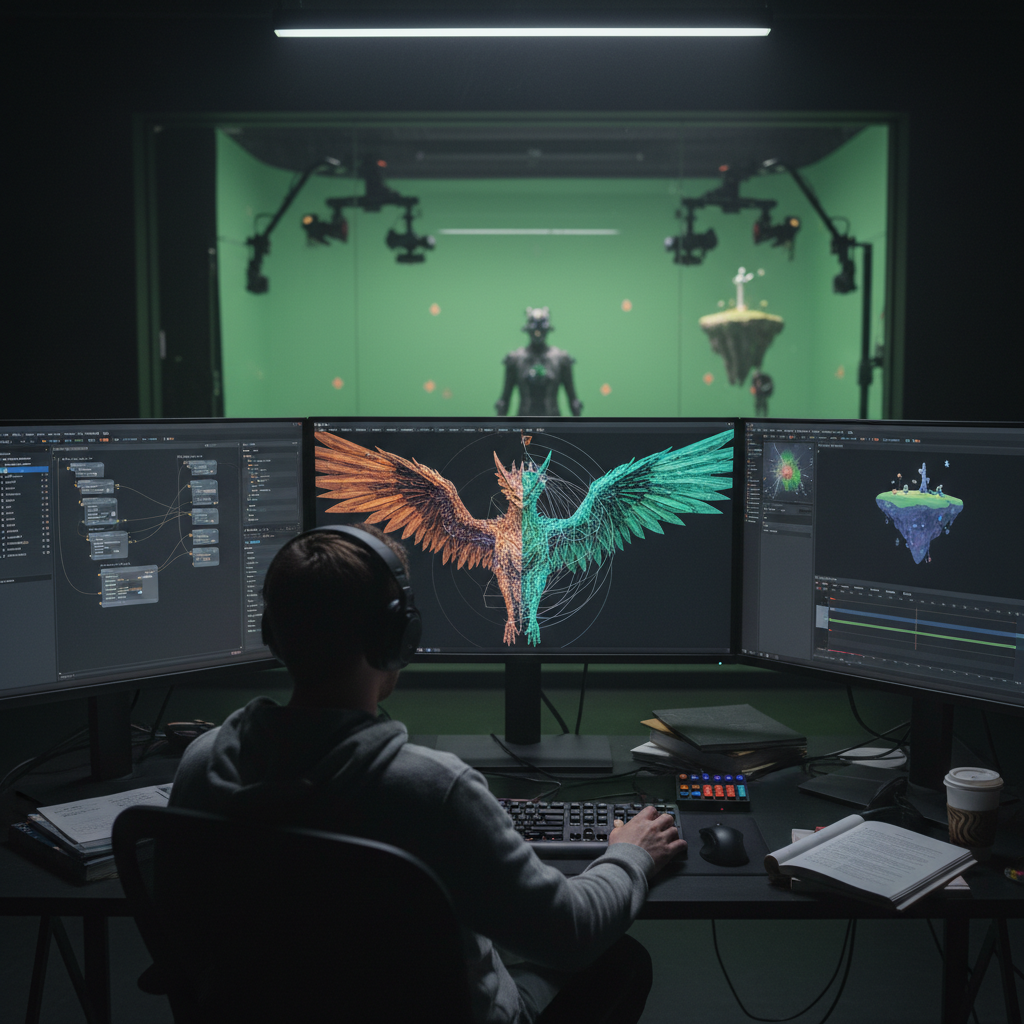
TL;DR: Modern cinema relies heavily on sophisticated visual effects (VFX) engineering to create immersive, impossible worlds. This article explores the core technologies—motion capture, procedural generation, advanced rendering, and compositing—that transform actor performances and creative visions into blockbuster spectacles. We examine how these engineering feats, often seen in films featuring actors like Chris Pratt, push the boundaries of computational power and artistic innovation, hinting at a future shaped by real-time engines and AI in virtual production.
Introduction: Beyond the Stars and Dinosaurs
Chris Pratt has become synonymous with blockbuster cinema, starring in franchises like Guardians of the Galaxy and Jurassic World. While his charismatic performances anchor these films, much of the spectacle surrounding him—from sentient trees and talking raccoons to genetically engineered dinosaurs and alien landscapes—is the product of incredibly sophisticated visual effects (VFX) engineering. These aren't just artistic flourishes; they represent a pinnacle of computational science, algorithmic design, and intricate pipeline management. For an engineering blog, understanding the "how" behind these cinematic marvels offers profound insights into large-scale data processing, real-time systems, and the relentless pursuit of photorealism.
The Invisible Infrastructure of Imagination
The journey from practical effects to digital mastery is a story of engineering innovation. Early visual effects relied on miniatures, matte paintings, and optical compositing—techniques that, while ingenious, were physically constrained. The advent of computer graphics (CG) in the 1970s and 80s, exemplified by films like Tron, began to unlock new possibilities. However, it was the 1990s, with films like Terminator 2 and Jurassic Park, that truly demonstrated the transformative power of digital VFX. These films didn't just add effects; they integrated CG characters and environments seamlessly, demanding robust software architectures, efficient rendering algorithms, and precise compositing workflows. Today, VFX pipelines are complex ecosystems involving hundreds of specialists and petabytes of data, all orchestrated to create a cohesive visual narrative.
Motion Capture: Bridging the Real and the Digital
A cornerstone of modern character animation, motion capture (MoCap) is vital for bringing digital characters to life with realistic movement and emotive performances. Actors like Chris Pratt often perform opposite actors in specialized MoCap suits, adorned with reflective markers. These markers are tracked by multiple cameras, generating vast datasets of 3D positional information. This raw data is then cleaned, processed, and applied to digital character rigs.
Beyond basic movement, performance capture integrates facial expressions and even eye movements, allowing a digital Rocket Raccoon or Groot to convey nuanced emotions directly from the actor's performance. The engineering challenge here lies in the precision of data acquisition, the robustness of tracking algorithms, and the efficient mapping of complex human motion onto often non-human digital anatomies, ensuring that the essence of the live performance is faithfully translated.
Procedural Generation and World Building
Creating the vast, detailed worlds seen in films like Guardians of the Galaxy's alien planets or Jurassic World's Isla Nublar would be impossible to hand-model entirely. This is where procedural generation becomes an indispensable engineering tool. Instead of manually crafting every rock, tree, or building, artists define rules, algorithms, and parameters. Software then generates complex geometries, textures, and landscapes automatically.
This approach is rooted in algorithmic design, leveraging fractals, L-systems, and noise functions to create organic, non-repeating patterns. It allows for rapid iteration and scalability, enabling the creation of entire digital ecosystems with a level of detail that would otherwise be prohibitively expensive and time-consuming. From generating cityscapes to simulating realistic foliage and geological formations, procedural techniques are critical for constructing believable, expansive digital environments.
Compositing and Rendering: The Final Synthesis
The magic of VFX often culminates in compositing, where disparate elements—live-action footage, CG characters, digital environments, and various effects layers—are meticulously combined into a single, cohesive image. This process requires sophisticated software that can blend elements seamlessly, matching lighting, color, and perspective.
Prior to compositing, individual CG elements must be rendered. Rendering is arguably the most computationally intensive phase of VFX production. It involves calculating how light interacts with every surface, material, and volume within a 3D scene. Physically Based Rendering (PBR) models simulate real-world physics of light, requiring immense processing power to achieve photorealism. Render farms, consisting of thousands of interconnected computers, work in parallel to compute millions of frames, often taking hours or even days to render a single high-resolution frame. This distributed computing challenge demands robust network infrastructure, efficient job scheduling, and advanced resource management systems.
The Human Element in a Digital Landscape
While technology drives VFX, the human element remains crucial. Directors, cinematographers, and actors must adapt to a workflow where much of the set is imaginary. Pre-visualization (pre-vis) and tech-vis are engineering-driven processes that create rudimentary 3D animations of complex scenes before principal photography. This allows filmmakers to plan camera angles, character blocking, and visual effects integration, essentially "rehearsing" the film digitally.
More recently, virtual production techniques, heavily influenced by game engine technology, are transforming filmmaking. Using LED walls displaying real-time rendered environments, actors can perform within a dynamic digital world visible on set. This provides immediate visual feedback, better informs actor performances, and dramatically reduces post-production compositing work, representing a significant shift towards real-time engineering in film.
The Future is Now: Real-time Engines and AI
The lines between film production and game development are increasingly blurring, largely due to the power of real-time engines like Unreal Engine and Unity. These engines, originally designed for interactive entertainment, are now being leveraged for film pre-visualization, virtual production, and even final pixel rendering. Their ability to render complex scenes instantly allows for unprecedented creative freedom and iteration speed, fundamentally changing VFX pipelines.
Furthermore, artificial intelligence (AI) is beginning to revolutionize various aspects of VFX. AI can assist with tasks like rotoscoping, object tracking, de-aging actors, generating realistic textures, and even automating animation processes. Machine learning algorithms are being trained on vast datasets of visual information to predict and generate elements that would traditionally require painstaking manual effort, promising a future where intelligent systems augment the creative and technical capabilities of VFX artists and engineers.
Conclusion: Crafting the Impossible
The cinematic worlds inhabited by characters played by actors like Chris Pratt are not merely flights of fancy; they are triumphs of engineering. From the precise data capture of motion to the algorithmic generation of entire ecosystems, and the distributed computing power required for photorealistic rendering, modern visual effects represent a frontier where art meets advanced technology. As computational power continues to grow and innovative techniques like virtual production and AI integration mature, the possibilities for crafting truly unreal worlds will only expand, pushing the boundaries of storytelling and visual spectacle. This continuous innovation ensures that the magic of cinema remains deeply rooted in the ingenuity of engineering.